Tuesday, December 16, 2008

O Antiphons


Don't forget the O Antiphons begin tomorrow. For an explanation of these, see the Fish Eaters entry here. Also, for ideas of how to celebrate this time in the Liturgical Year, O Night Divine blog is an excellent resource!
Catholic Culture has several ideas, here and here.

The "O Antiphons"

December 17
O Wisdom, Who didst come out of the mouth of the Most High, reaching from end to end and ordering all things mightily and sweetly: come and teach us the way of prudence.

December 18
O Adonai, and Leader of the house of Israel, Who didst appear to Moses in the flame of the burning bush, and didst give unto him the Law on Sinai: come and with an outstretched arm redeem us.

December 19
O Root of Jesse, Who dost stand for an ensign of the people, before Whom kings shall keep silence, and unto Whom the Gentiles shall make their supplication: come to deliver us, and tarry not.

December 20
O Key of David and Sceptre of the house of Israel, Who dost open and no man doth shut, Who dost shut and no man doth open, come and bring forth from his prison-house the captive that sitteth in darkness and in the shadow of death.

December 21
O Dawn of the East, Brightness of the Light Eternal and Sun of Justice, come and enlighten them that sit in darkness and in the shadow of death.

December 22
O King of the Gentiles and the Desired of them, Thou Cornerstone that dost make both one, come and deliver man, whom Thou didst form out of the dust of the earth.

December 23
O Emmanuel, our King and Lawgiver, the Expected of the Nations and their Saviour, come to save us, O Lord our God.

Thursday, December 11, 2008

Retreat, RETREAT!!

Yes, I am retreating! I have not been on an Ignatian Retreat in about 6 years. I am looking forward to the peacefulness, but I am also in panic mode trying to get everything here ready for me to be gone for 8 (yes, 8) days. I am tempted to cancel - there is just too much to do with school, Christmas, and, and, . . . I learned from my first retreat to ignore this temptation. I never went when my older kids were little (under 6) because I could not leave them. Then during the retreat I realized that this was going to help them as much as it helped me. I should have been there much sooner. I went every two years after that, then when Michael came along, all those feelings came back - I just could not leave him. I am still having those feelings, but I know in my heart that I will be a better mom, wife, and Catholic on my return.
So, I am gone for a while. Keep the watch and please let me know what all I miss! Your prayers are very much appreciated.
Oh, I forgot to mention that I am retreating in warm, sunny, Phoenix! It will be a nice break from the 40ish weather we have been having here in NC!
I have scheduled some liturgical season posts to go up while I am away,

Wednesday, December 10, 2008

Homeschooling

Finally a chance to write about homeschooling!
We began with a serious schedule in September and for the most part still maintain it except on Mondays when we deliver Meals on Wheels which often runs over the allotted scheduled time. And there are those days where we are just not in the mood to school, but nevertheless, we have met our goals for the first semester in the basic subjects.
I try to almost always use Catholic materials in schooling, yet when I first looked into the Spell to Write and Read program, I was impressed enough to investigate it further. After speaking with some people that use it, I decided this was the program I wanted to use with my then 4 year old. After studying it more deeply, I was intimidated! I actually had the materials for a year before I started teaching just the single phonograms. Then I hit a block. I study the Yahoo group files, I studied the books, and I floundered. Finally, I went to a 2-day intensive seminar on how to teach reading, writing, and spelling using this program. It was just what I needed and I have not looked back. (Although the Catholic curriculums still make me blink every once in a while.) At first I was bored because we spent several weeks learning to write all the single phonograms (sounds) in cursive (using the companion Cursive First program). When it finally came time to pull out my Wise Guide to Spelling along with my Spell to Write and Read teacher's book, I was more than excited to apply the many things I learned from the seminar.
Now, after 12 weeks, we are on the "D" list of 20 spelling words and we love it. Michael is "reading" 80 spelling words now fairly fluently. The hard thing with this program is that reading is somewhat delayed which is the opposite of what I have always striven for. Yet he, rather WE, are learning the why's and what's of spelling. At first I thought there was no way he would get the markings, rules, and other "complicated" aspects down, but he grasps them much easier than I do. The intimidation came back yesterday as I realized that I would be teaching the reference page on the "Silent Final E' today. It just seems like a lot for a 5.5 year old to comprehend. I reviewed my own working notebook from the seminar and studied the section in the book. I only taught the first 3 reasons for a silent, final "e" this morning, and my son loved it. His words, "This is lots of fun!" Wow, who would have thought learning about why E is silent at the end of words could be fun???
OK, who can name the five reasons for the silent E?

Tuesday, December 9, 2008

Bishop Malooly's Explanation

Now we have a Bishop talking about following his "own conscience". What about Church teachings?

From Lifenews.com:
http://lifenews.com/state3691.html

Joe Biden’s Bishop Expands on Decision Not to Deny Communion Over Abortion

by Steven Ertelt
LifeNews.com Editor
December 7, 2008

Add to My Yahoo! Email RSS Printer

Dover, DE (LifeNews.com) -- Bishop W. Francis Malooly has expanded on his previous comments that he will not deny communion to incoming Vice-President Joe Biden because of his pro-abortion position. Malooly says he can do more good by not alienating Biden and other pro-abortion Catholic politicians.

"My own conscience tells me I have a better chance of helping someone if I don't alienate" that person, he said during a conference for young Catholics over the weekend.

Bishop Malooly said he was following the lead of most of the other Catholic bishops in the United States who have not revoked the sacrament for pro-abortion elected officials and have instead adopted a more conciliatory approach to changing their hearts and minds on abortion.

According to a report in the Wilmington News-Journal, Bishop Malooly, who was recently installed as the head of the Catholic Church in Delaware and Maryland’s eastern shore, said his dealing with pro-abortion politicians who deviate from pro-life Catholic teachings is nothing new.

He said as the auxiliary bishop for the Archdiocese of Baltimore that he dealt with the contentious communion issues.

Malooly told the newspaper that "I don't know everyone's conscience” and can't make decisions about abortion and communion on a broad basis but must confront people who are out of step with the church one-on-one.

Last month, Malooly said he wouldn't deny Biden communion even though several of his fellow bishops have done so.

"I won't politicize the Eucharist," Malooly said. "I don't want to alienate people. I want to change their hearts and minds."

Malooly said he spoke with Biden in September on the day before his installation as the new bishop and the two agreed to discuss the issue of abortion and Catholic pro-life teachings at a later date.

Biden attends church weekly and has received communion at his hometown church in Delaware.

Tuesday, December 2, 2008

A Few Advent Things


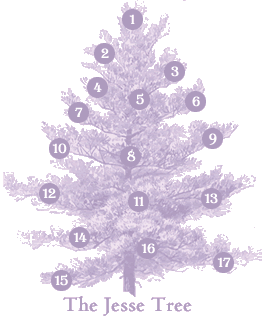
For those who are not making a Jesse Tree in their homes, Catholic Culture has an online Jesse Tree. This gives you a short meditation and appropriate readings. Just click on the day of Advent.

For more info on the Jesse Tree see here.

Another great Advent resource is found at Domestic Church here.

Sunday, November 30, 2008

St. Andrew Novena begins today!

The St. Andrew Novena begins today. It is piously believed that whoever recites this prayer fifteen times a day from the feast of St. Andrew (30th November) until Christmas will obtain what is asked.

"Hail and blessed be the hour and moment in which the Son of God was born of the most pure Virgin Mary, at midnight, in Bethlehem, in piercing cold. In that hour, vouchsafe, O my God! to hear my prayer and grant my desires, through the merits of Our Saviour Jesus Christ, and of His Blessed Mother. Amen."


Imprimatur
+MICHAEL AUGUSTINE, Archbishop of New York
New York, February 6, 1897

Free Shipping at Angelus - Monday

From free to shining free.

FREE SHIPPING!

For one day only!

Monday, December 1st
on all US orders
(by phone or online)

Our customer service personnel
– Mary Anne Hall, John Rydholm, and Rebecca Heatwole –
will be available on Monday, December 1 from 6am - 9pm CST.
Take a peek at our new titles!

Tuesday, November 25, 2008

Reception of the Holy Eucharist

An excellent read from an interview with Archbishop Raymond Burke who was appointed by the Holy Father to serve as the Prefect of the Apostolic Signatura. The Supreme Tribunal of the Apostolic Signatura is the administrative appellate tribunal of the Holy See and, consequently, the highest judicial authority of the Catholic Church besides the Pope himself.

The Holy Eucharist: A Right or a Gift?
Examining the pastoral aspects of Canon 915 and respect for the Holy Eucharist.
Interview by Thomas J. McKenna
Catholic Action for Faith and Family
August 2008

Here are a couple of "teasers" to peak your interest (my emphasis added):
These would just be some of the elements which I think have entered in and explain the lax attitude toward the Holy Eucharist, in general. We see this even in the way people dress for participation in Mass. For example, we see during Mass people going up to receive Holy Communion not folding their hands and even sometimes visiting with others along the way. Some, even at the time they are actually receiving Holy Communion, do not show the proper reverence. All of these are indications of the need of a new evangelization regarding Eucharistic faith and practice.
and, one of the questions posed to Archbishop Burke:
Some people say that it is a right to receive Holy Communion and that no one else hasthe right to tell another not to receive the Sacrament. Not even a bishop, priest or minister. What would you respond to them?
Seems a note-worthy question for recent events . . . so go and read the full article!


Thursday, November 20, 2008

South Carolina Priest Had Support Originally (then there is that tax-exempt thing that seems to get in the way)

A very interesting story about the Administrator of Charleston's initial response to Fr. Newman was one of praise . . . HERE
Something that was interesting to me was this quote from the article:
As an exclusive, I have attached below a letter sent out by Msgr. Laughlin in October gravely warning priests against presenting anything from the pulpit that could be interpreted by the IRS as threatening the Church’s tax exempt status.
Please read the article to get the full story.

Wednesday, November 19, 2008

Interesting Read on the Pro-Life Movement and Why It Is Not Working

There has been a lot of talk lately about the failure of the pro-life movement among Catholics. I pulled out one of my favorite articles last night to re-read and could not help but post it here. I hope this will inspire a lively, but intelligent discussion on this subject. I ask that all refrain from personal attacks - this is for discussion and presents, what I think, is an argument well worth consideration (and soul-searching!). Please read carefully, think about it, and then respond.
The article was written all the way back in 2002 by Robert Siscoe. It is found in its entirety below, but can also be found here in the archives of the now defunct online Seattle Catholic. Seattle Catholic was an Internet-based publication that ran from 2001-2006. It is a great resource for articles on many Catholic matters.

Seattle Catholic
A Journal of Catholic News and Views
29 Jun 2002
The Problem with the Pro-life Movement
by Robert Siscoe

To win the battle against abortion, we must take the ax to the root!

In the spiritual life – as we are overcoming sins and perfecting ourselves – we often discover that in fighting against a particular fault, the fault we are attacking is actually an effect of a deeper root cause. At first, we may be unaware of the deeper root and begin attacking the fault with little or no lasting success. It is not until we discover – by God's grace – the deeper root cause of the particular fault, and begin to attack it, that our true victory is gained. Just as in our personal spiritual lives we often discover a deeper root cause for our sins, similarly in other areas of life there is often a deeper root cause that has produced the manifest evil. This work will focus primarily on the cause that produced legalized abortion and our "culture of death," and show what must be done to correct the situation.

Abortion is surely a most heinous sin; not only is it murder, but it is murder of the most innocent. These innocent babies are created by God and for God, yet their lives are snuffed out before they are even born. Many people, whose eyes are open to the evils of abortion, fight for the lives of these unborn babies with truly heroic courage, yet the abortions continue. In 1997, the CDC reported that there were just over 1.18 Million abortions in the US alone; it was reported this year that during 2000 there were a total of 1.37 Million abortions, which is slightly higher than the average yearly abortion rate since 1985. With all of the Rosaries, Masses, and sacrifices offered to God, why is the number of abortions not decreasing? Is the fight being waged on the wrong front? Is the symptom being attacked while the disease goes undetected? In the fight to end abortion, we must seek to find the root cause that has produced it; and after finding the cause, we must "take the ax to the root."

So, what is the deeper root cause that has led to abortion and our culture of death? Abortion is a moral issue; our objective moral values are based on our religion, and our religion on our faith. A person with little or no religion usually has weak moral values. Similarly, when faith is weakened, the logical effect will be a lowering of morality. Pope Leo XIII tells us, "when the mind has... become poisoned, the moral character becomes at the same time deeply and substantially corrupt." He further tells us that "it is the light of Christian faith which is the principal and foundation of all righteousness." It follows, then, that if the Christian faith, which the Pope calls the "foundation of all righteousness," is diminished, the effect will be a lessening of moral values; and it is logical to conclude that until the faith is restored, the morality it upholds will not return.

If we look back over recent history, we see that this indeed is what happened: First the faith was attacked and weakened; the weakening of faith then resulted in a lowering of morality; finally, the lowering of morals paved the way for our culture of death. Therefore, to end our culture of death, we must fight the effect at its cause; that is, we must restore moral values by restoring the faith.

As was stated above, abortion is surely one of the worst of all sins, however, according to Catholic theology, heresy is the greatest of all sins: "The sin of unbelief [heresy] is greater than any sin which occurs in the perversion of morals." (St. Thomas Aquinas) This is because murder (abortion being one of the worst forms) is an attack on a creature, while heresy is a direct attack on God Himself. What is heresy? Heresy is the rejection of a truth revealed by God; that is, the rejection of a truth contained in the "deposit of faith" handed down by Tradition, and proclaimed true by the Church. If a person rejects even one truth of the faith, that person is objectively a heretic. "He who dissents even in one point from divinely revealed truth absolutely rejects all faith," said Pope Leo XIII in the Encyclical Satis Cognitum. He then goes on to quote St. Augustine as saying: "'In many things they [the heretics] are with me, in a few things they are not with me; but in the few things which they are not with me the many things in which they are will not profit them.'"

We are now living in a day when the true faith, as taught by the Church for 1900 years, is nearly dead. In a strange twist of logic, we are now told that what used to be wrong is right, and that what used to be right is now wrong. Many of the clergy, who are supposed to be our shepherds in the faith, have instead become "wolves" leading the flock into error. This disorientation has produced the expected results: The faithful are confused. With so many contrary voices, they do not know who, or what, to believe: We are indeed in a crisis of faith! The statistics tell the sad story: most Catholics living today are objectively heretics. A survey conducted by Gallup Poll between December 1991 and January 1992 indicated that 70% of the Catholics polled held a heretical belief in the Doctrine of the Holy Eucharist. A later poll released by the same organization indicated that weekly Mass attendance by Catholics in the U.S. dropped from 75% in 1958, down to 50% in 1971, and down to only 19% in 1999. We can see from this poll that even before abortion was legalized, Sunday Mass attendance had dropped 33% in only 11 years. Moreover, between 1965 and 1973, approximately 22,000 to 25,000 priests left the priesthood. These statistics show that even before abortion was legalized, the faith was diminishing at an astounding rate.

The many contradictory voices emanating from the clergy have literally poisoned the minds of the faithful. Recall the words of Pope Leo XIII: "when the mind has... become poisoned, the moral character becomes at the same time deeply and substantially corrupt."

This drastic loss of faith among Catholics has produced – as its effect - a lowering of morality; the lowering of morality thus laid the groundwork for our culture of death. Therefore, to end the culture of death we must "take the ax to the root" by restoring the faith; but to restore the faith we must first remove the poison that corrupted it. This leads us to the next question: What initially led to the loss of faith? To find the answer to this question we need only read the encyclical letters of the guardians of our faith, the Roman Pontiffs. The primary duty of the Pope is to guard the integrity of the faith, and our Holy Fathers have done so brilliantly. They repeatedly warned the faithful of the snares of the enemy, and of the poison that was being infused into the "roots". Let us now take a look at several of the errors that our Holy Fathers have warned us to be on guard against.

In 1907, Pope St. Pius X, the only Pope Canonized in the 20th century, warned the Bishops to be on guard against the enemies within the Church. He warned that these internal enemies "lay the ax not to the branches and shoots, but to the very root, that is to the Faith and its deepest fibers. And once having struck at this root of immortality, they proceed to diffuse poison through the whole tree so that there is no part of Catholic truth which they leave untouched, none that they do not strive to corrupt... and this so craftily that they easily lead the unwary into error." (Pascendi)

Who were these enemies the Pope was referring to, and what were their plans? They were the modernists, and their plan was to "reform" the Church based on their erroneous teachings. The Pope said: "These partisans of errors are to be sought not only among the Church's open enemies; but, what is to be most dreaded and deplored, in her very bosom, and are the more mischievous the less they keep in the open. We allude, Venerable Brethren, to many who belong to the Catholic laity, and what is much more sad, to the ranks of the priesthood itself, who, animated by a false zeal for the Church, lacking the solid safeguards of philosophy and theology, nay more, thoroughly imbued with the poisonous doctrines taught by the enemies of the Church, and lost to all sense of modesty, put themselves forward as reformers of the Church..." (ibid.) (Note: For a detailed account of these erroneous reforms read the encyclical Pascendi Dominici Gregis, Pope St. Pius X, and to see them implemented, visit your average American Parish.)

In addition to the modernist "reforms" that Pope St. Pius X warned of - which have led to the lessening of faith - we were warned of another grave error, which, Pope Pius XI said, threatened the very foundations of the Catholic faith. What was this "grave error" that threatened the very foundations of the Catholic faith? It was the current ecumenical movement!

In 1929, in the Encyclical "Mortalium Animos" (On Fostering True Religious Unity – a must read for every Catholic), Pope Pius XI again warned of these "enemies within" and of the false movement toward "unity". In the hope to achieve this unity, the Pope tells us that: "[Ecumenical] meetings and addresses are arranged, attended by a large concourse of hearers, where all without distinction, believers of every kind as well as Christians, even those who unhappily have rejected Christ and denied His divine nature or mission, are invited to join in the discussion (dialogue). Now, such efforts can meet with no kind of approval among Catholics. They presuppose the erroneous view that all give expression, under various forms, to that innate sense which leads men to God and to the obedient acknowledgement of His rule. Those who hold such a view are not only in error; they distort the true idea of religion and thus reject it, falling gradually into naturalism and atheism. To favor this opinion, therefore, and to encourage such undertakings is tantamount to abandoning the religion revealed by God."

In the encyclical, he gives instructions on how to attain true Christian unity and warned the Bishops to not be misled by those who sought unity at any price: "[W]hen there is a question of fostering unity among Christians it is easy for many to be misled by the apparent excellence of the object to be achieved. 'Is it not right', they ask, 'is it not the obvious duty of all who invoke the name of Christ to refrain from mutual reproaches and at last to be united in charity? Dare anyone say that he loves Christ and yet not strive with all his might to accomplish the desire of Him who asked His Father that His disciples might be 'one'? (John 17:21). ...If only Christians were 'one' it is contended, then they might do so much more to drive out the danger of irreligion which, with its insidious and far-reaching advance, is threatening to sap the strength of the Gospel.' These and similar arguments, are constantly on the lips of the 'pan-Christians'... The energy with which this scheme is being promoted has won for it many adherents, and even many Catholics are attracted by it, since it holds out hope of a union apparently constant with the wishes of Holy Mother Church... In reality, however" the Pope warns, "these fair and alluring words cloak a most grave error, subversive to the foundations of the Catholic Faith."

The pope tells us that this false drive towards unity leads to the subversion of the very foundations of the Catholic Faith and the practical abandonment of true religion, both of which are the foundation for upholding moral values. Unfortunately, the warnings of this encyclical have not only been ignored for the past 35 years, but what the Pope condemned as destructive to the Catholic faith is now the driving force towards Christian unity. And the internal enemies Pope St. Pius X warned of, who wanted to "reform" the Church based on their erroneous teachings, have now reformed the Church based on their erroneous teachings. We are now witnessing the result of these "reforms" and of this 'unity at any price': The foundations of the Catholic Faith are being destroyed.

This false ecumenism has led to the Catholic Faith – which should be the foundation of unity – becoming, for them, a stumbling block to "unity"; therefore, the stumbling block has been gradually disregarded and weakened, and unity is now sought in a "new" way. No longer is unity sought the way Jesus chose – within the true faith - but "in diversity".

In February 2001, Cardinal Walter Kasper, President of the Pontifical Council for Promoting Christian Unity, defined the current ecumenical movement when he stated: "Today we no longer understand ecumenism in the sense of the ecumenism of return, by which the others would 'be converted' and return to being 'Catholics'... each church has its own riches and gifts of the Spirit, and it is this exchange that unity is trying to be achieved, and not in the fact that we should become 'Protestants', or that the others should become 'Catholics' in the sense of accepting the confessional form of Catholicism."

This kind of "unity" brings to mind the words of Pope St. Pius X: "...religion itself is allowed to go to ruin. 'Blind' they are, and 'leaders of the blind' puffed up... they have reached the pitch of folly at which they pervert the concept of truth and the true meaning of religion; and in introducing a new system in which 'they are seen to be under the sway of a blind and unchecked passion for novelty." Disregarding the Faith for the sake of unity, however, has not led to the desired result (nor could it), but rather it has led to a degeneration of Faith, which - as has been repeated - has led to a lowering of morals resulting in our "culture of death". When the faith is again restored – and it will be one day - the morality it fosters will return; but neither of these will be restored until we "remove the poison from the root," as Pope St. Pius X put it. Unity is not something that can be sought to the detriment of the faith. We cannot suffer the faith to be compromised for the mere appearance of unity: "If they did this" said Pope Pius XI, "they would be giving countenance to a false Christianity quite alien to the one Church of Christ. Shall we commit the iniquity of suffering the truth, the truth revealed by God, to be made subject of compromise?" Unity should be desired by all, but true unity will only be achieved within the guidelines set down by God; that is, within the true faith. "The true union between Christians is that which Jesus Christ, the Author of the Church, instituted and desired, and which consists in a unity of faith and a unity of government." (Pope Leo XIII, The Reunion of Christendom, 1894)

The current ecumenical movement, however, is not seeking a true unity within the faith, but a unity based on the notion of "fraternal love", as it is called. Unity is no longer sought the way God desires, but out of merely human motives, to the exclusion of God's Will. "It is not for any human motive" said Pope Leo XIII, "but impelled by divine charity and a desire for the salvation of all, that We advise the reconciliation and union with the Church of Rome; and We mean a perfect and complete union, such as could not subsist in any way if nothing else was brought about but a certain kind of agreement in the tenets of belief and an intercourse of fraternal love." (ibid.) Unity founded merely on 'fraternal love' is not true unity, and the result of this false unity is, as Pope Pius XI said, the practical abandonment of True religion.

"But some through enthusiasm for an imprudent 'eirenism' (ecumenism) seem to consider as an obstacle to the restoration of fraternal union, things founded on the laws and principals given by Christ... which are the defense and support of the integrity of the Faith, and the removal of which would bring about the union of all, but only to their destruction." (Pius XII, On Certain False Opinions, 1950).

Unfortunately, we did not heed the warnings of our previous Popes; and we are now reaping the fruits of this disobedience. Is there any surprise, then, that the faith has been weakened laying the groundwork for our culture of death? (We often see manifest physically that which first takes place spiritually: in this case death.)

Through this destruction of faith, morals have become such that we are now in a virtual pagan society. Christianity has become so weakened over the past 40 years that there is no longer a Christian moral force upholding the values of society. Is there any surprise that the war on abortion is not having better success? Without the faith being restored we should not expect a moral recovery.

Abortion: a triple victory for Satan?

Is abortion a triple victory for Satan? In addition to the most obvious evil, murder, is Satan also using the abortion issue as a diversionary tactic? And as a means of promoting false ecumenism which "threatens the very foundations of the Catholic Faith"? (Pope Pius XI)

Just as God can bring good out of evil, so Satan can bring evil out of an apparent good. What a victory for Satan if he could not only use the abortionists for murder, but use the pro-life movement to infuse his poison into the root of the tree through false ecumenism. And what if at the same time he could divert the fervent Catholics attention away from the cause of the evil (the loss of faith) to wage war on its effect (deteriorating morals and abortion)?

While driving in my car several months ago, I turned on the radio and heard, probably the leading Pro-life Priest in the U.S., telling how successful the pro-life movement has been in promoting Ecumenism. He stated that, because of the pro-life movement, Catholics have begun working together with their Jewish, Protestant and Mormon "brothers" and have come to a better understanding of them and their religions. Is this not helping to destroy the faith, while fighting its effect?

If we were to attack the effect (abortion), while being diverted from – or worse still - promoting the cause that produced it (loss of faith through false ecumenism and religious indifferentism), would we not be adding fuel to the fire that we are trying to extinguish? Would it not be like trying to put out the flames of a fire by spraying it with gasoline?

Let us imagine that one night, while everyone slept, a water pipe burst in a beautiful Cathedral. The water began to poor out onto the hard wood floors. In the morning when the parishioners arrived for Mass, the water was running out of the front doors. Frantically everyone joined in to soak up the water. Many of the parishioners stayed all day to attempt to clean up the water so as to save the flooring, however, they were making little progress because no one bothered to stop the leak. In fact, the pipe was beginning to leak water at a greater speed. They were working frantically with all their might to save the floors, but their work produced little fruit because they never fixed the leak.

Fighting abortion while neglecting its cause is like trying to dry up spilled water without stopping the leak; the one causes the other. Could Satan, "that crafty enemy of mankind and a murderer from the beginning" as Leo XIII called him, be diverting our attention from the cause of the problem, by inspiring us to fight, with all our might, its effect?

Moreover, if we recall that heresy is objectively a greater sin than abortion, how can we unite with heretics to fight what is objectively a lesser evil than what they stand for? Can we commit a sin against Faith – or at least risk becoming indifferent to religion - under the appearance of good? Can we break the 1st commandment in the hope of stopping another from breaking the 5th? No, we cannot sin that good may come. As Cardinal Newman said, "we cannot commit even a venial sin, with the hope of attaining a good end."

"The devil has succeeded in infiltrating evil under the appearance of good... worst of all, the devil has succeeded in leading into error and deceiving souls having a heavy responsibility through the position they hold." (Sister Lucy of Fatima)

What would a pro-life Catholic say if a group of Catholics were to unite with a group of abortion doctors to fight Protestantism? And what if, after engaging in their efforts for several years, the Catholics discovered that 'the abortion doctors have many good qualities. In addition to providing occasional abortions they also do much good to save lives; they are respectable members of the community, and their children are good kids'; and what if they were to conclude "Isn't the abortion issue dividing us? Maybe we should all just set aside our differences with regard to abortion for now and unite in the fight against heresy; after all, we would fight heresy much better if we were united; and didn't Jesus pray that we all should be "one"?' Obviously, we can see that this would be false reasoning. Nevertheless, are we not falling into the same error by uniting with heretics to fight abortion?

Just as it is not appropriate to put aside our differences with an abortion doctor to fight heresy, so it is not appropriate to put aside our differences with heretics to fight abortion. Do we really believe that God will be pleased if we unite with those of a false religion – who are perishing in their unbelief – for the purpose of the pro-life movement? Has our faith so weakened over the past 35 years, and have we become so indifferent with regard to religion, that we believe salvation is possible by the profession of any faith as long as they share our moral values? One who believes that each person has the right to choose their own morality has fallen into the error of moral relativism; and one who believes that each person is free to chose their own religion has fallen into the error of religious indifferentism. Relativism is to morals what indifferentism is to faith.

In the Catechism, under the heading "How does a Catholic sin against faith," we have a definition of indifferentism: "Indifferentism is the error of those who hold that one religion is as good as another... or that one is free to accept or reject any or all religions." After reading this definition, we must ask ourselves: have we become indifferent? Do we believe that one is free to choose any religion they like, or that salvation is attainable by the profession of any religion as long as morality is maintained? Pope Leo XIII referred to this kind of indifference as a deadly error: "Now We consider another abundant source of the evils, which the Church is afflicted at present: indifferentism. This perverse opinion is spread on all sides by the fraud of the wicked who claim that it is possible to obtain eternal salvation of the soul by the profession of any kind of religion, as long as morality is maintained. Surely, in so clear a matter, you will drive this deadly error far from the people committed to your care." (Mirari Vos)

We must be careful not to sin against faith – thus weakening it - while performing an act of charity. How could it be that the Faith should be undermined through Charity? Let us never forget the words of Pope St. Pius X: "The primary duty of charity does not lie in the toleration of false ideas, however sincere they may be; nor in the theoretical or practical indifference toward the errors and vices in which we see our brethren plunged..." (Our Apostolic Mandate)

In the above encyclical, Pope St. Pius X was condemning a false movement, which originated in France, known as the Sillon. He condemned their false notion of fraternity - a fraternity based merely on a common interest. He said that their "notion of fraternity, which they found on the love of common interest or, beyond all philosophies and religions, on the mere notion of humanity" was false and dangerous. He said, "there is no true fraternity outside of Christian Charity." And as Pope Leo XIII asked: "How can hearts be united in perfect charity where minds do not agree in faith?" (The reunion of Christians) True fraternity must be within Christian charity, and Christian charity must have - as its foundation - the Catholic faith. It is not sufficient to have a fraternity founded merely on a common moral interest outside of Christian charity. This would be false charity and a danger to the true faith. "If, as we desire with all our heart, the highest possible peak of well-being for society and its members is to be attained through fraternity... all minds must be united in the knowledge of the Truth (true faith), all wills united in morality, and all hearts in the love of God and His Son Jesus Christ. But this union is attained only by Catholic charity." The Pope says it is essential that fraternity be founded on both Faith and morals. He further states: "separating fraternity from Christian charity... would mean a disastrous step backwards." (Our Apostolic Mandate, Pope St. Pius X)

The Sillonists were a group of Catholics who united with Protestants and Freethinkers in the pursuit of a common end. They thought it appropriate to put aside their differences with regard to religion to attain the common goal. The Pope quotes one of their leaders as saying:

Sillon: "'Catholic comrades will work among themselves. Protestants and Freethinking Democrats will do likewise on their own side. But all of us, Catholics, Protestants and Freethinkers will have a heart to arm young people, not in view of the fratricidal struggle, but in view of a disinterested emulation in the field of social and civic virtues.'"

Although they were working in separate groups, the Pope concludes the quote by saying: "These declarations and this new organization of the Sillonist action call for very serious remarks. Here we have, founded by Catholics, an interdenominational association that is to work for" their common end. He says: "what must be thought of the indiscriminate mingling in which your Catholics will be caught up with heterodox and unbelieving folk in a work of this nature? Is it not a thousand-fold more dangerous for them than a neutral association... What are we to think of this respect for all errors and of this strange invitation made by Catholics to all the dissidents to strengthen their convictions?"

Let us look now at some quotes from the leading pro-life movement in Catholicism in light of the warnings of Pope St. Pius X:

On the website of Priests for Life we find the following statement under the heading "We Are Ecumenical":

Priests For Life: "The pro-life movement consists of men and women of every religious persuasion, and some of no religious persuasion. Priests for Life serves the entire movement. We therefore eagerly work together with everyone interested in ending abortion."

Compare that statement with the above quote from the Sillon and you will see that the similarities are striking. In both cases, religious differences are put aside to attaining a common goal. There is, however, one difference: with regard to the Sillon, each religious group worked amongst themselves separately; while the pro-life movement is working, not in separate groups, but completely intermingled. In an interview with the Priest who heads Priests for Life, the interviewer concludes the article by saying: "He said he works a lot with ministers of other denominations and that in the pro-life movement he has found the ecumenism he had been longing and praying for. There are few, if any, things that foster practical day to day ecumenism like the pro-life movement does, because people are "in the trenches together..."

The problem with this type of "ecumenism" is that it promotes everything that causes indifferentism. Ecumenism is supposed to be the process of converting those of a false religion to the true religion; what it has instead become is the act of putting aside our religious differences (i.e. indifferentism) for the sake of getting along. Unfortunately, without realizing it, many in the pro-life movement are promoting a false ecumenism which leads to what Pope Leo XIII referred to as the "deadly error" (i.e. mortal sin) of indifferentism. Without a very strong faith – which is rare today - uniting with Protestants and others of a false religion will inevitably lead to this grave error.

How will uniting with those of a false religion lead to indifferentism? God gives each person natural good qualities; these qualities are to be used in the service of God, and to show forth God's goodness. If a person becomes entangled in a false religion, they do not lose their God-given natural good qualities. If we are working together on a regular basis with people of a false religion, it will inevitably happen that we will see their good qualities and be attracted by them. The result will be that we will begin to like the person and respect his good qualities. If we do not possess a very strong faith, it will be a very short step from respecting the person to respecting their false religion. That is why it used to be forbidden for a Catholic to even work with heretics (now referred to as 'separated brethren'), because of the possible danger to their faith.

We live in a day when we are greatly tempted to become indifferent. It is difficult to remain true to the "faith of God" when we are so often confronted with friendly people of false religions. Working with them in a common cause only makes matters that much more difficult. That is why Pope Saint Pius X condemned the Sillon who were working with those of other religions when he said: "what must be thought of the indiscriminate mingling in which young Catholics will be caught up with heterodox and unbelieving folk in a work of this nature? Is it not a thousand-fold more dangerous for them than a neutral association? What are we to think of this appeal to all the heterodox, and to all the unbelievers, to prove the excellence of their convictions in the social sphere... What are we to think of this respect for all errors and of this strange invitation made by Catholics to all the dissidents to strengthen their convictions... What are we to think of an association in which all religions and even Free Thought may express themselves openly and in complete freedom? For the Sillonist who, in public lectures and elsewhere, proudly proclaim their personal (Catholic) faith, certainly do not intend to silence others, nor do they intend to prevent a Protestant from asserting his Protestantism... Alas! Yes, the ambiguity has been broken: the social action of the Sillon is no longer Catholic..." (Our Apostolic Mandate)

Why was their social action no longer Catholic? The answer is simple: Because they set aside their faith to accomplish it. How much better could the Sillon have accomplished their goals by not mingling with those of false religions? Did they really believe that God would bless their work if they, for all practical purposes, denied Him? Would it not have been 'a thousand-fold' more beneficial and pleasing to God if they would not have risked becoming indifferent by mingling with those of false religions?

It is very easy to loose our faith, through religious indifferentism, in a society like ours which has so many religions intermingled; this is a great temptation for all of us. Even Solomon, with all his wisdom, fell into the error of religious indifferentism. This happened as a result of his becoming to close with those of other religions. He eventually disobeyed God and married many women from "strange nations". "And king Solomon loved many strange women... of the nations concerning which the Lord said to the children of Israel: You shall not go in unto them, neither shall any of them come in to yours, for they will most certainly turn your heart away to follow their gods. And to these Solomon joined with a most ardent love. And he had seven hundred wives as queens, and thee hundred concubines: and the women turned away his heart." He began to love these women, and thus he began to accept their false religions. As stated above, it is a very short step from liking a person to accepting their religion. Even the wise Solomon fell into this deadly error: "And when he was now old, his heart was turned away by women to follow strange gods: and his heart was not perfect with the Lord his God, as was the heart of David his father... And Solomon did that which was not pleasing before the Lord, and did not fully follow the Lord, as David his father. Then Solomon built a temple for Chamos the idol of Moab, on the hill that is over against Jerusalem, and for Moloch the idol of the children of Ammon. And he did in this manner for all his wives... and burnt incense, and offered sacrifices to their gods. And the Lord was angry with Solomon... And the Lord therefore said to Solomon: Because thou hast done this, and hast not kept my covenant, and my precept which I have commanded thee, I will divide thy kingdom." (3 Kings 11:1-11)

We read that Solomon's heart was not perfect before God, as was the heart of his father David. Now we know that David fell into the sin of adultery (2 Kings 11:4) as well as murder (vs.15), yet God forgave these sins (ch.12:13). However, the sin of religious indifferentism that Solomon fell into led to the destruction of the kingdom. We can see from this how serious a matter it is to become indifferent towards God's religion. Let us never forget that Catholicism is not our religion, it is God's religion, we have only been given the grace to be members of it.

If we have a strong faith, it may be possible to respect the person while realizing that their religion is false. We have a good example of this in St. Patrick. While in Ireland he grew to love the Irish people, but he did not accept their religion. St. Patrick possessed a very strong faith; therefore, impelled by Divine Charity, he went back to Ireland and converted the Irish to Catholicism, and they have always loved him for that. This, however, requires a strong faith, which is not a particular mark of our times.

We must constantly be on our guard against religious indifferentism or we put our own salvation at risk. What good will it do to promote an honorable cause if we lose our own faith in the process? We should never forget these words from Scripture: "Without faith it is impossible to please God."

As a test of our faith, let us read an infallible dogma of the Catholic Church. This will help us to see if we have become indifferent with regards to religion. Keep in mind that an infallible dogma is a teaching of the Catholic Church which all Catholics are bound to believe. This dogma is a good test of our faith as it is one of the most politically incorrect dogmas of our day and it does not leave any room for religious indifferentism.

In 1442, at the council of Florence, Pope Eugene IV, in the Bull Cantante Domino, declared infallibly that no one can attain salvation except in the Catholic Church, and that all those who die outside of the Church will suffer the eternal fires of hell:

"The Most Holy Roman Church firmly believes, professes and preaches that none of those existing outside of the Catholic Church, not only pagans, but also Jews, heretics, and Schismatics can ever be partakers of eternal life, but that they are to go into the eternal fire 'which was prepared for the devil and his angels', unless before death, they are joined with Her;... no one, even if he pour out his blood for the Name of Christ, can be saved unless they abide within the bosom and unity of the Catholic Church."

If we have a difficulty with this dogma of our Holy Faith it is probably because we have become indifferent. And if we say we believe this dogma, we must ask ourselves: do we really believe it? or, have we so water down its meaning that it has become, what Pope Pius XII called, a meaningless formula: "Some reduce to a meaningless formula the necessity of belonging to the true Church in order to gain eternal salvation." (Pius XII, On certain false opinions, 1950)

The reason indifferentism is such a "grave error" is because our faith is a primary bond that unites us to God. If we become indifferent with regard to our faith, we risk severing that bond. God must always come first, and if we sin for the sake of a moral cause, we are serving the moral cause instead of God; thus, it becomes our god. We certainly have a duty to fight evil – especially an evil as great as abortion - but only in a manner that is pleasing to God. There is no need to unite with those of a false religion, and risk our own faith, to fight abortion; we can fight abortion just fine without endangering our faith. God does not need large numbers, only faithful people, and a faithful person is one who has not severed his relationship with God. "In His divine wisdom, He [God] ordained in His Church Unity of Faith; a virtue which is the first of those bonds which unites man to God, and whence we receive the name faithful..." (Satis Cognitum) That is why God inspired St. John to write: "If any man come to you, and bring not this doctrine, receive him not into the house nor say to him, God speed you. For he that saith unto him, God speed you, communicateth with his wicked works." (2 Jn 1:10-11)

Conclusion

Abortion is a great evil, but the loss of faith is greater still. Back in 1931, Hilaire Beloc wrote the following: "Our civilization developed as a Catholic civilization. It developed and matured as a Catholic thing. With the loss of Faith it will slip back not only to Paganism, but into barbarism with the accomplishments of Paganism..." (The New Paganism) We are now living in the day he described. In a pagan culture, there is very often child sacrifice, that is one of the marks of a pagan society. The solution is not putting aside religious differences and uniting with "moral" pagans to fight abortion; the solution is to end our pagan society by restoring the faith. If the faith is restored, morality will return and abortion will end; but if we fight to restore morals without restoring the faith we will never accomplish our goal. Therefore, the solution to ending abortion, and many other evils of today, is to restore the faith.

"Just as Christianity cannot penetrate in the soul without making it better, so it cannot enter public life without establishing order,,, If it has transformed pagan society -–and that transformation was a veritable resurrection – for barbarism disappeared in proportion as Christianity extended its sway, so, after the terrible shocks which unbelief has given to the world in our days, it will be able to put that world again on the true road, and bring back to order the states and peoples of modern times. But the return of Christianity will not be efficacious and complete if it does not restore the world to a sincere love of the One, Holy, Catholic and Apostolic Church." (Leo XIII Review of His Pontificate pg. 566-567)

When our Lady of Guadalupe appeared to Juan Diego, child sacrifice was the religion of the day. To end the evil of child sacrifice, Our Lady did not organize a protest, She took the ax to the root and converted the pagans to the Catholic faith. Therefore, let us learn a lesson from Our Lady of Guadalupe and end our modern-day child sacrifice by restoring the faith. It will do little good to fight the effect (abortion) if we are not at the same time fighting the cause that produced it (loss of faith). Every child saved is a victory gained, but in the long run, where is the victory if the child grows up in a pagan home and dies only to suffer the eternal fires of hell? And what shall we say if we are fighting abortion while actually adding fuel to the cause that produced it? Is this not what will happen if we become indifferent, and thus loose our faith, by fighting a moral issue that resulted from a lessening of faith? Is this not a deadly spiral that will not only never accomplish the goal, but destroy the faith of millions of Catholics in the process? Remember the words of Sister Lucy of Fatima: "The devil has succeeded in infiltrating evil under the appearance of good..."

Let us re-think our means of fighting abortion so that we do not offend God while trying to serve Him. If our goal is merely to fight abortion, we can continue on our current path; but if we seek to eliminate it, let us do our part to restore the faith, because when the faith has been restored, abortion will end. Therefore, I end with this appeal to the pro-life Catholics of the world who are seeking to end abortion: Take the ax to the root!

Robert Siscoe
Elizabethtown, Kentucky
6/29/2002

© Copyright 2001-2006 Seattle Catholic. All rights reserved.

Tuesday, November 18, 2008

Fr. Newman and the Church's Stand

As you all can tell from my lack of posts, I do not have much time to spend here, but feel like this is too important to only link to from my Google Reader.
A scandal (my perception) has resulted from a South Carolinian priest's request (note that I had to use an external source since the Diocese has removed it from the parish's website) and the Administrator of the Diocese's reply.
Barbara Kralis does an excellent job of presenting Fr. Newman's justification for his announcement and causing us all to ask, "What in the world is this Administrator thinking". Her article is posted on RenewAmerica. You can find her entire article in two parts here1 and here2.

Some excerpts:

Solemn and Ordinary Magisterial Teachings

  • "The Church stresses that a well-formed Christian conscience does not permit one to vote for a political program or an individual law which contradicts the fundamental contents of faith and morals.... John Paul II, continuing the constant teaching of the Church, has reiterated many times that those who are directly involved in lawmaking bodies have a 'grave and clear obligation to oppose' any law that attacks human life.

    "For them, as for every Catholic, it is impossible to promote such laws or to vote for them" [1]

  • "Presenting oneself to receive Holy Communion should be a conscious decision, based on a reasoned judgment regarding one's worthiness to do so, according to the Church's objective criteria, asking such questions as: 'Am I in full communion with the Catholic Church? Am I guilty of grave sin? Have I incurred a penalty [e.g. excommunication, interdict] that forbids me to receive Holy Communion? Have I prepared myself by fasting for at least an hour?' The practice of indiscriminately presenting oneself to receive Holy Communion, merely as a consequence of being present at Mass, is an abuse that must be corrected." [2]

  • "If we tell ourselves that the Church ought not to interfere in such matters, we cannot but answer: are we not concerned with the human being? Do not believers, by virtue of the great culture of their faith, have the right to make a pronouncement on all this? Is it not our duty to raise our voices to defend the human being, that creature who, precisely in the inseparable unity of body and spirit, is the image of God?" [3]

  • "Among all the crimes which can be committed against life, procured abortion has characteristics making it particularly serious and deplorable" [Pope John Paul II, 'Evangelium vitae,' n.58].

  • In treating the evil of procured abortion, Pope John Paul II concluded: "No circumstance, no purpose, no law whatsoever can ever make licit an act which is intrinsically illicit, since it is contrary to the Law of God which is written in every human heart, knowable by reason itself, and proclaimed by the Church" [Pope John Paul II, 'Evangelium vitae,' n.62d].

  • "Laws, which authorize and promote abortion... [are] radically opposed not only to the good of the individual but also to the common good; as such they are completely lacking in authentic juridical validity. Disregard for the right to life, precisely because it leads to the killing of the person whom society exists to serve, is what most directly conflicts with the possibility of achieving the common good. Consequently, a civil law authorizing abortion or euthanasia ceases by that very fact to be a true, morally binding civil law. [Pope John Paul II, 'Evangelium vitae,' n.72].

  • "To claim the right to abortion, infanticide and euthanasia, and to recognize that right in law, means to attribute to human freedom a perverse and evil significance: that of an absolute power over others and against others. This is the death of true freedom: 'Truly, truly, I say to you, every one who commits sin is a slave to sin'" Jn 8:34 [Pope John Paul II, 'Evangelium vitae,' n.20].

  • "The Church's custom shows that it is necessary for each person to examine himself at depth, and that anyone who is conscious of grave sin should not celebrate or receive the Body of the Lord without prior sacramental confession, except for grave reason when the possibility of confession is lacking; in this case he will remember that he is bound by the obligation of making an act of perfect contrition, which includes the intention to confess as soon as possible. Moreover, the Church has drawn up norms aimed at fostering the frequent and fruitful access of the faithful to the Eucharistic table and at determining the objective conditions under which Communion may not be given [Ecclesia de Eucharistia n. 42]. It is certainly best that all who are participating in the celebration of Holy Mass with the necessary dispositions should receive Communion. Nevertheless, it sometimes happens that Christ's faithful approach the altar as a group indiscriminately.

    "It pertains to the Pastors prudently and firmly to correct such an abuse." [4]

  • "Abortion and euthanasia are thus crimes which no human law can claim to legitimize. There is no obligation in conscience to obey such laws; instead there is a grave and clear obligation to oppose them by conscientious objection. From the very beginnings of the Church, the apostolic preaching reminded Christians of their duty to obey legitimately constituted public authorities [cf. Rom 13:1-7; 1 Pet 2:13-14], but at the same time it firmly warned that 'we must obey God rather than men' [Acts 5:29]. ... It is precisely from obedience to God -to whom alone is due that fear which is acknowledgment of his absolute sovereignty — that the strength and the courage to resist unjust human laws are born. It is the strength and the courage of those prepared even to be imprisoned or put to the sword, in the certainty that this is what makes for 'the endurance and faith of the saints' [Rev 13:10].
  • Friday, November 14, 2008

    Communion of Saints

    An acquaintance forwarded me an article today. It really made me think about the Communion of Saints. Many Catholics I know do not even know what this is more less practice it! An excellent and must read from the archives of the now non-existent Seattle Catholic can be found here.

    Here an excerpt from the article about the protest at the annual meeting of the US Bishops:
    Bishop Sheen once said, “We priests usually don’t lose our souls because we do evil. Rather, we lose our souls because we fail to do good.” This “failure to do good” was reflected in the latest Election. One of the greatest tragedies of the 2008 presidential race is that most bishops, with some exceptions, simply made a weak pro-life statement, or signed a joint pro-life document, or printed a pro-life article in their diocesan newspapers. They never mobilized the faithful to effectively fight for the unborn.
    And then a reminder of some valuable Church teaching from Wikipedia:

    CHURCH MILITANT AND CHURCH TRIUMPHANT
    The Church Militant and the Church Triumphant
    by Andrea da Firenze

    The Catholic Church, or Church Universal, is traditionally divided into:

    • the Church Militant (Ecclesia Militans), comprising Roman Catholics who are living,
    • the Church Triumphant (Ecclesia Triumphans), comprising those who are in Heaven, and
    • the Church Suffering (Ecclesia Penitens) or Church Expectant (Ecclesia Expectans), comprising those Christians presently in Purgatory. This last term is used mainly in Roman Catholicism.

    These terms are often used in the context of the doctrine of the Communion of Saints; although Christians may be physically separated from each other by the barrier of death, they nonetheless remain united to each other in one Church, and support each other in prayer.

    The Latin word militans has a primary meaning of "serving as a soldier, military", but it acquired a secondary meaning of "to struggle, to make an effort", which is the intended sense here. Christians on earth (the Church Militant) are still struggling against sin in order that, when they die, they might go to heaven and be members of the Church Triumphant, those who have triumphed over sin. However, if this struggle is successful, but not completely so, then after death they temporarily become members of the Church Suffering before ultimately joining the Church Triumphant.

    The Catholic Church commemorates the Church Triumphant and the Church Suffering on two consecutive days: All Saints Day on November 1 (the Church Triumphant), and All Souls Day on November 2 (the Church Suffering).

    Friday, November 7, 2008

    Words to Ponder

    Some words from Fr. Corapi concerning America's "choice" (kind of ironic, isn't it?):

    "The American people have now made it abundantly clear who they want to lead them, and the policies and practices that this president-elect has represented for some time, they can now claim as their own.
    Actions have consequences, and I am sure God has duly noted what our priorities are in the US of A. Economic matters would seem to take precedence over moral matters; money more important than life itself to most people (I guess they don't consider almost 50,000,000 innocent
    children murdered by abortion part of life).
    Now we shall see what the fruit of such a tree will be. I predict that we won't have to wait long. In recent months we have seen "corrections" in the stock market, housing market, and banking
    industries. Now we'll see if God orchestrates a "correction" in a country and a world that has demonstrated quite clearly that it prefers convenience and wealth to life itself.
    Regardless of whatever happens next, remember there is still a God in Heaven and He loves you. He is infinitely merciful—and He is infinitely just as well."

    God Bless You

    Fr. John Corapi

    Wednesday, November 5, 2008

    Post Election Thoughts

    OK, it is over and the pro-abortion candidate won. I have thought about a rant I would like to go on, but am resigned to God's Will. We prayed, we sacrificed, we hoped . . . and the majority of voters chose Obama. I believe God sends us tests, just as He tested the Angels and Adam and Eve. Sometimes it may be little tests of our faith or our obedience, and sometimes there are bigger stakes. I believe that we failed this test and I also believe there will be a sentence. That said, I will pray for our future president and all our leaders just as I pray for the present.
    Now, can someone please explain the following article to me. I heard it from the SSPX pulpit, and the bishops of North Carolina "ordered" a statement to be read at Masses, as did many bishops throughout the United States. So why did such a large percentage of Catholics vote for Obama? Excuse me, but I am labeled the "disobedient" one for attending SSPX Masses . . . ????????????
    From the Catholic News Service:
    Catholic voters mirror general electorate in support for Obama

    WASHINGTON (CNS) -- Catholics pretty much voted the way the rest of the country did in supporting Democratic Sen. Barack Obama in the presidential race Nov. 4, according to some early poll reports. Exit poll data was still being compiled and analyzed Nov. 5, but early information showed 53 percent or 54 percent of Catholics supported Obama and 44 percent or 45 percent were for Republican Sen. John McCain. Of the total population, 52 percent of Americans voted for Obama and 46 percent for McCain. By comparison, 52 percent of Catholics in 2004 supported Republican President George W. Bush and 47 percent voted for Democratic Sen. John Kerry. The total nationwide vote in 2004 was 55 percent for Bush and 44 percent for Kerry. Final pre-election polls from battleground states showed there would likely be some differences between the Catholic vote and the overall vote in those states, however.

    Tuesday, November 4, 2008

    Fasting on Election Day

    From an acquaintance . . .


    Esther 4:12-17

    12 When Esther's words were reported to Mordecai, 13 he sent back this answer: "Do not think that because you are in the king's house you alone of all the Jews will escape. 14 For if you remain silent at this time, relief and deliverance for the Jews will arise from another place, but you and your father's family will perish. And who knows but that you have come to royal position for such a time as this?"

    15 Then Esther sent this reply to Mordecai: 16 "Go, gather together all the Jews who are in Susa, and fast for me. Do not eat or drink for three days, night or day. I and my maids will fast as you do. When this is done, I will go to the king, even though it is against the law. And if I perish, I perish."

    17 So Mordecai went away and carried out all of Esther's instructions.

    Fasting was the "God-given' strategy when Esther recognized the urgency of the hour to speak up and save the lives of her people. The United States is in an "Esther moment" as Americans vote for their leaders on November 4th.

    Sunday, October 26, 2008

    Nine-Day Rosary Novena Prior to the US Election

    Please remember that the 9-day Rosary novena starts tomorrow. For more info see Catholic Family News

    Catholic Family News urges you to join us in a

    Nine-Day Rosary Novena
    Prior to the US Election

    From October 27 to November. 4.

    Please forward this email to as many as possible…

    Whether you plan to vote for John McCain, Chuck Baldwin, Ron Paul or no one at all.
    Join us in the Rosary Novena and in the daily recitation of
    a special approved prayer against “revolutionary men”.


    PLEASE ALSO RECITE ON EACH DAY OF THE NOVENA
    THIS PRAYER
    APPROVED BY THE CHURCH
    Prayer given by Our Lord to Sister Marie de Sainte Pierre (1816-1848 – Apostle
    of the Holy Face of Jesus), to divide and conquer revolutionary men.

    Eternal Father, I offer Thee the Cross of Our Lord Jesus Christ, and all the instruments of His Holy Passion that Thou mayest put division in the camp of Thine enemies, for as Thy beloved Son hath said, "a kingdom divided against itself shall fail".

    Thursday, October 9, 2008

    New Sidebar Item

    Dont' forget to scroll down a bit and check out the new gadget - the bloglist. It lets me view my favorite blogs through Google Reader and select posts to share on my blog. I often find items I want to share, but do not like just posting a link to another site, so this lets me share all the wonderful articles I find. And it also makes my limited morning reading time much easier. I have a simple lists of the blogs I like to check in daily with the new posts. I can peruse from one page without having to go to each individual site and I can share some great things with YOU! I will clear out the list each Sunday and start over again with new items, so make sure to check it out during the week.

    Thursday, October 2, 2008

    Feast of Our Holy Guardian Angels


    We celebrate our Guardian Angels today remembering to give thanks to God for giving each of us a special friend and to thank them for taking care of us and asking for their continual guidance and love. Here is our special treat for the day - Angel Food cake with fresh strawberries and blueberries and a dollop of whipped cream!

    Monday, September 29, 2008


    Our October art study will center around knowing, loving, and serving God. What better example to put forth than St. Bernard, so we will be studying the above print by Italian painter Filippino Lippi, along with a couple of other prints I have around the house. This print is titled "Apparation of the Virgin to St. Bernard". We begin with a look at the detail art print of the angels found in CHC's Art Masterpieces and will move out to examine the print as a whole.

    Saturday, September 27, 2008

    Next Week's Liturgical Year

    As I plan my school week next week (yes, I only do one week at a time as I am never sure what I will get done or what tangents we may take off on), I am so excited about the upcoming feast days. While each week offers a chance to appreciate the year that the Catholic Church brings to us through its liturgical calendar, next week will be extra special to a certain 5-year old who has his favorite saints. We may be partying all week instead of schooling!
    We begin with St. Wenceslaus on Sunday. We will take this day to imitate the saint by giving - going through our toys and clothes to find appropriate ones to donate to those in need - not just the ones we do not want, but also some of our favorites so there is a real sacrifice. Also, we will remember his service to the poor when we deliver meals to the elderly on Mondays. See here for the story of this saint.
    On Monday comes a namesake. Michael looks forward to the great feast of his namesake, the Dedication of St. Michael the Archangel. Here is a link to a coloring page from Waltzing Maltida's blog, and since one of his many titles is patron saint of baker's, we will bake a special cake for the dinner celebration in additon to our special waffles for breakfast. I suspect a re-enactment of the battle of the good angels and the bad angels will definitely be on the schedule.
    Tuesday's saint is St. Jerome, and we will read St. Jerome and the Lion for fun, but also focus on his great contribution to translating the bible.
    Wednesday is the feast day of a saint we have not studied, St. Remigius. We will read his story and briefly study Reims, France with a look at the famous Gothic cathedral, the Cathedral of Our Lady of Reims.
    The Holy Guardian Angels feast day is on Thursday. Again, I am sure there will be a reenactment of the Fall of the Bad Angels. We will pay extra attention to our own guardian angel by making sure we have an extra table setting for each family member beside him during meals and a special art project, yet to be determined. And of course, there is the Angel Food cake with fresh strawberries!
    Friday brings our favorite saint to read about. St. Therese of the Child Jesus has a natural appeal to all young children because of her simplicity. We will read several of our stories about St. Therese's life along with making sacrifice beads and hopefully, make some potpourri.
    Lastly, on Saturday is another namesake, St. Francis of Assisi. A short study of the Basillica of St. Francis will be included and hopefully, we will be able to take at the least our dog, for a blessing. This may have to be done by dad. Hopefully, we will get the story, St. Francis and the Wolf of Gubbio, read. Our parish put this play on a couple of years ago and Michael really enjoyed it.
    Well, that is a start to my layout for next week. I have not included activities from CHC's A Year with God or Mary Reed Newland's The Year and Our Children, which I use alot as resources. But these will be incorporated into my plans, more than likely, very late tonight!

    Friday, September 26, 2008

    Blog Follower

    I have added Google's new feature, Blog Follower, to the sidebar. I am excited about using this as it will make it very handy to keep up with my favorite blogs. If you want to add it to your blog, click here or just go to your customize tab and add the new gadget

    Friday, September 12, 2008

    More Pius X

    Following up on my last post, here are some excerpts from Pascendi Dominici Gregis (On the Doctrine of the Modernist). Please note that these words come from the only Pope to be canonized in the twentieth century! Again, look at the foresight of this pope. I heard recently that he is the least often quoted pope today - I wonder why??? Note highlights are mine.

    28. Thus then, Venerable Brethren, for the Modernists, both as authors and propagandists, there is to be nothing stable, nothing immutable in the Church. Nor indeed are they without precursors in their doctrines, for it was of these that Our Predecessor Pius IX wrote: These enemies of divine revelation extol human progress to the skies, and with rash and sacrilegious daring would have it introduced into the Catholic religion as if this religion were not the work of God but of man, or some kind of philosophical discovery susceptible of perfection by human efforts. On the subject of revelation and dogma in particular, the doctrine of the Modernists offers nothing new - we find it condemned in the Syllabus of Pius IX., where it is enunciated in these terms: Divine revelation is imperfect, and therefore subject to continual and indefinite progress, corresponding with the progress of human reason; and condemned still more solemnly in the Vatican Council: The doctrine of the faith which God has revealed has not been proposed to human intelligences to be perfected by them as if it were a philosophical system, but as a divine deposit entrusted to the Spouse of Christ to be faithfully guarded and infallibly interpreted. Hence the sense, too, of the sacred dogmas is that which our Holy Mother the Church has once declared, nor is this sense ever to be abandoned on plea or pretext of a more profound comprehension of the truth. Nor is the development of our knowledge, even concerning the faith, impeded by this pronouncement - on the contrary it is aided and promoted. For the same Council continues: Let intelligence and science and wisdom, therefore, increase and progress abundantly and vigorously in individuals and in the mass, in the believer and in the whole Church, throughout the ages and the centuries - but only in its own kind, that is, according to the same dogma, the same sense, the same acceptation.
    42. . . . The Modernists pass judgment on the holy Fathers of the Church even as they do upon tradition. With consummate temerity they assure the public that the Fathers, while personally most worthy of all veneration, were entirely ignorant of history and criticism, for which they are only excusable on account of the time in which they lived. Finally, the Modernists try in every way to diminish and weaken the authority of the ecclesiastical magisterium itself by sacrilegiously falsifying its origin, character, and rights, and by freely repeating the calumnies of its adversaries. To the entire band of Modernists may be applied those words which Our predecessor sorrowfully wrote: "To bring contempt and odium on the mystic Spouse of Christ, who is the true light, the children of darkness have been wont to cast in her face before the world a stupid calumny, and perverting the meaning and force of things and words, to depict her as the friend of darkness and ignorance, and the enemy of light, science, and progress.''[23] This being so, Venerable Brethren, there is little reason to wonder that the Modernists vent all their bitterness and hatred on Catholics who zealously fight the battles of the Church. There is no species of insult which they do not heap upon them, but their usual course is to charge them with ignorance or obstinacy. When an adversary rises up against them with an erudition and force that renders them redoubtable, they seek to make a conspiracy of silence around him to nullify the effects of his attack. This policy towards Catholics is the more invidious in that they belaud with admiration which knows no bounds the writers who range themselves on their side, hailing their works, exuding novelty in every page, with a chorus of applause. For them the scholarship of a writer is in direct proportion to the recklessness of his attacks on antiquity, and of his efforts to undermine tradition and the ecclesiastical magisterium. When one of their number falls under the condemnations of the Church the rest of them, to the disgust of good Catholics, gather round him, loudly and publicly applaud him, and hold him up in veneration as almost a martyr for truth. The young, excited and confused by all this clamor of praise and abuse, some of them afraid of being branded as ignorant, others ambitious to rank among the learned, and both classes goaded internally by curiosity and pride, not infrequently surrender and give themselves up to Modernism.


    Monday, September 8, 2008

    St. Pius X

    I did not have time last week to recognize St. Pius X's feastday here, so I now post one of his greatest Encyclicals, the Syllabus condemning the modernists. Please read the list of errors and look at the state of many of our Catholic parishes today. What foresight this great Saint had and how his words are forgotten today!
    Saint Pius X, pray for us!

    From Papal Encyclicals Online :

    Lamentabili Sane

    (Condemning the Errors of the Modernists)
    Sacred Congregation of the Holy Office
    July 3, 1907

    WITH TRULY LAMENTABLE RESULTS, our age, casting aside all restraint in its search for the ultimate causes of things, frequently pursues novelties so ardently that it rejects the legacy of the human race. Thus it falls into very serious errors, which are even more serious when they concern sacred authority, the interpretation of Sacred Scripture, and the principal mysteries of Faith. The fact that many Catholic writers also go beyond the limits determined by the Fathers and the Church herself is extremely regrettable. In the name of higher knowledge and historical research, (they say), they are looking for that progress of dogmas which is, in reality, nothing but the corruption of dogmas.

    These errors are being daily spread among the faithful. Lest they captivate the faithful's minds and corrupt the purity of their faith, His Holiness, Pius X, by Divine Providence, Pope, has decided that the chief errors should be noted and condemned by the Office of this Holy Roman and Universal Congregation.

    Therefore, after a very diligent investigation and consultation with the Reverend Consultors, the Most Eminent and Reverend Lord Cardinals, the General Inquisitors in matters of faith and morals have judged the following proposals to be condemned and proscribed. In fact, by this current decree, they are condemned and proscribed.

    1. The ecclesiastical law which prescribes that books concerning the Divine Scriptures are subject to previous examination does not apply to critical scholars and students of scientific exegesis of the Old and New Testament.
    2. The Church's interpretation of the Sacred Books is by no means to be rejected; nevertheless, it is subject to the more accurate judgment and correction of the exegetes.
    3. From the ecclesiastical judgments and censures passed against free and more scientific exegesis, one can conclude that the Faith the Church proposes contradicts history and that Catholic teaching cannot really be reconciled with the true origins of the Christian religion.
    4. Even by dogmatic definitions the Church's magisterium cannot determine the genuine sense of the Sacred Scriptures.
    5. Since the Deposit of Faith contains only revealed truths, the Church has no right to pass judgment on the assertions of the human sciences.
    6. The "Church learning" and the "Church teaching" collaborate in such a way in defining truths that it only remains for the "Church teaching" to sanction the opinions of the "Church learning."
    7. In proscribing errors, the Church cannot demand any internal assent from the faithful by which the judgments she issues are to be embraced.
    8. They are free from all blame who treat lightly the condemnations passed by the Sacred Congregation of the Index or by the Roman Congregations.
    9. They display excessive simplicity or ignorance who believe that God is really the author of the Sacred Scriptures.
    10. The inspiration of the books of the Old Testament consists in this: The Israelite writers handed down religious doctrines under a peculiar aspect which was either little or not at all known to the Gentiles.
    11. Divine inspiration does not extend to all of Sacred Scriptures so that it renders its parts, each and every one, free from every error.
    12. If he wishes to apply himself usefully to Biblical studies, the exegete must first put aside all preconceived opinions about the supernatural origins of Sacred Scripture and interpret it the same as any other merely human document.
    13. The Evangelists themselves, as well as the Christians of the second and third generations, artificially arranged the evangelical parables. In such a way they explained the scanty fruit of the preaching of Christ among the Jews.
    14. In many narrations the Evangelists recorded, not so much things that are true, as things which, even though false, they judged to be more profitable for their readers.
    15. Until the time the canon was defined and constituted, the Gospels were increased by additions and corrections. Therefore there remained in them only a faint and uncertain trace of the doctrine of Christ.
    16. The narrations of John are not properly history, but a mystical contemplation of the Gospel. The discourses contained in his Gospel are theological meditations, lacking historical truth concerning the mystery of salvation.
    17. The fourth Gospel exaggerated miracles not only in order that the extraordinary might stand out but also in order that it might become more suitable for showing forth the work and glory of the Word Incarnate.
    18. John claims for himself the quality of witness concerning Christ. In reality, however, he is only a distinguished witness of the Christian life, or the life of Christ in the Church at the close of the First Century.
    19. Heterodox exegetes have expressed the true sense of the Scriptures more faithfully than Catholic exegetes.
    20. Revelation could be nothing else than the consciousness man acquired of his revelation to God.
    21. Revelation, constituting the object of the Catholic faith, was not completed with the Apostles.
    22. The dogmas the Church holds out as revealed are not truths which have fallen from heaven. They are an interpretation of religious facts which the human mind has acquired by laborious effort.
    23. Opposition may, and actually does, exist between the facts narrated in Sacred Scripture and the Church's dogmas which rest on them. Thus the critic may reject as false facts the Church holds as most certain.
    24. The exegete who constructs premises from which it follows that dogmas are historically false or doubtful is not to be reproved as long as he does not directly deny the dogmas themselves.
    25. The assent of faith ultimately rests on a mass of probabilities.
    26. The dogmas of the Faith are to be held only according to their practical sense; that is to say, as perceptive norms of conduct and not as norms of believing.
    27. The divinity of Jesus Christ is not proved from the Gospels. It is a dogma which the Christian conscience has derived from the notion of the Messias.
    28. While He was exercising His ministry, Jesus did not speak with the object of teaching He was the Messias, nor did His miracles tend to prove it.
    29. It is permissible to grant that the Christ of history is far inferior to the Christ Who is the object of faith.
    30. In all the evangelical texts the name "Son of God" is equivalent only to that of "Messias." It does not in the least way signify that Christ is the true and natural Son of God.
    31. The doctrine concerning Christ taught by Paul, John and the Councils of Nicea, Ephesus and Chalcedon is not that which Jesus taught but that which the Christian conscience conceived concerning Jesus.
    32. It is impossible to reconcile the natural sense of the Gospel texts with the sense taught by our theologians concerning the conscience and the infallible knowledge of Jesus Christ.
    33. Everyone who is not led by preconceived opinions can readily see that either Jesus professed an error concerning the immediate Messianic coming or the greater part of His doctrine as contained in the Gospels is destitute of authenticity.
    34. The critics can ascribe to Christ a knowledge without limits only on a hypothesis which cannot be historically conceived and which is repugnant to the moral sense. That hypothesis is that Christ as man possessed the knowledge of God and yet was unwilling to communicate the knowledge of a great many things to His disciples and posterity.
    35. Christ did not always possess the consciousness of His Messianic dignity.
    36. The Resurrection of the Savior is not properly a fact of the historical order. It is a fact of merely the supernatural order (neither demonstrated nor demonstrable) which the Christian conscience gradually derived from other facts.
    37. In the beginning, faith in the Resurrection of Christ was not so much in the fact itself of the Resurrection, as in the immortal life of Christ with God.
    38. The doctrine of the expiatory death of Christ is Pauline and not evangelical.
    39. The opinions concerning the origin of the Sacraments which the Fathers of Trent held and which certainly influenced their dogmatic canons are very different from those which now rightly exist among historians who examine Christianity.
    40. The Sacraments had their origin in the fact that the Apostles and their successors, swayed and moved by circumstances and events, interpreted some idea and intention of Christ.
    41. The Sacraments are intended merely to recall to man's mind the ever-beneficent presence of the Creator.
    42. The Christian community imposed the necessity of Baptism, adopted it as a necessary rite, and added to it the obligation of the Christian profession.
    43. The practice of administering Baptism to infants was a disciplinary evolution, which became one of the causes why the Sacrament was divided into two, namely, Baptism and Penance.
    44. There is nothing to prove that the rite of the Sacrament of Confirmation was employed by the Apostles. The formal distinction of the two Sacraments of Baptism and Confirmation does not pertain to the history of primitive Christianity.
    45. Not everything which Paul narrates concerning the institution of the Eucharist (1 Corinthians 11:23-35) is to be taken historically.
    46. In the primitive Church the concept of the Christian sinner reconciled by the authority of the Church did not exist. Only very slowly did the Church accustom herself to this concept. As a matter of fact, even after Penance was recognized as an institution of the Church, it was not called a Sacrament since it would be held as a disgraceful Sacrament.
    47. The words of the Lord, "Receive the Holy Spirit; whose sins you shall forgive, they are forgiven them; and whose sins you shall retain, they are retained" (John 20:22-23), in no way refer to the Sacrament of Penance, in spite of what it pleased the Fathers of Trent to say.
    48. In his Epistle (Chapter 5:14-15) James did not intent to promulgate a Sacrament of Christ but only commend a pious custom. If in this custom he happens to distinguish a means of grace, it is not in that rigorous manner in which it was taken by the theologians who laid down the notion and number of the sacraments.
    49. When the Christian supper gradually assumed the nature of a liturgical action those who customarily presided over the supper acquired the sacerdotal character.
    50. The elders who fulfilled the office of watching over the gatherings of the faithful were instituted by the Apostles as priests or bishops to provide the necessary ordering of the increasing communities and not properly for the perpetuation of the Apostolic mission and power.
    51. It is impossible that Matrimony could have become a Sacrament of the new law until later in the Church since it was necessary that a full theological explication of the doctrine of grace and the Sacraments should first take place before Matrimony should be held as a Sacrament.
    52. It was far from the mind of Christ to found a Church as a society which would continue on earth for a long course of centuries. On the contrary, in the mind of Christ the kingdom of heaven together with the end of the world was about to come immediately.
    53. The organic constitution of the Church is not immutable. Like human society, Christian society is subject to a perpetual evolution.
    54. Dogmas, Sacraments and hierarchy, both their notion and reality, are only interpretations and evolutions of the Christian intelligence which have increased and perfected by an external series of additions the little germ latent in the Gospel.
    55. Simon Peter never even suspected that Christ entrusted the primacy in the Church to him.
    56. The Roman Church became the head of all the churches, not through the ordinance of Divine Providence, but merely through political conditions.
    57. The Church has shown that she is hostile to the progress of the natural and theological sciences.
    58. Truth is no more immutable than man himself, since it evolved with him, in him, and through him.
    59. Christ did not teach a determined body of doctrine applicable to all times and all men, but rather inaugurated a religious movement adapted or to be adapted to different times and places.
    60. Christian Doctrine was originally Judaic. Through successive evolutions it became first Pauline, then Joannine, finally Hellenic and universal.
    61. It may be said without paradox that there is no chapter of Scripture, from the first of Genesis to the last of the Apocalypse, which contains a doctrine absolutely identical with that which the Church teaches on the same matter. For the same reason, therefore, no chapter of Scripture has the same sense for the critic and the theologian.
    62. The chief articles of the Apostles' Creed did not have the same sense for the Christians of the first age as they have for the Christians of our time.
    63. The Church shows that she is incapable of effectively maintaining evangelical ethics since she obstinately clings to immutable doctrines which cannot be reconciled with modern progress.
    64. Scientific progress demands that the concepts of Christian doctrine concerning God, creation, revelation, the Person of the Incarnate Word, and Redemption be re-adjusted.
    65. Modern Catholicism can be reconciled with true science only if it is transformed into a non-dogmatic Christianity; that is to say, into a broad and liberal Protestantism.
    The following Thursday, the fourth day of the same month and year, all these matters were accurately reported to our Most Holy Lord, Pope Pius X. His Holiness approved and confirmed the decree of the Most Eminent Fathers and ordered that each and every one of the above-listed propositions be held by all as condemned and proscribed.
    Peter Palombelli
    Notary, Congregation for the Propagation of the Faith