 On the 1962 liturgical calendar, we have the Seven Sorrows of Our Blessed Mother. For an excellent meditation on Our Lady's Sorrows, go here.
Showing posts with label Art. Show all posts
Showing posts with label Art. Show all posts
Friday, April 3, 2009
The Seven Sorrows of Our Blessed Mother
On the 1962 liturgical calendar, we have the Seven Sorrows of Our Blessed Mother. For an excellent meditation on Our Lady's Sorrows, go here.


Wednesday, April 1, 2009
Rogier van der Weyden
Crucifixion Altarpiece, c. 1445 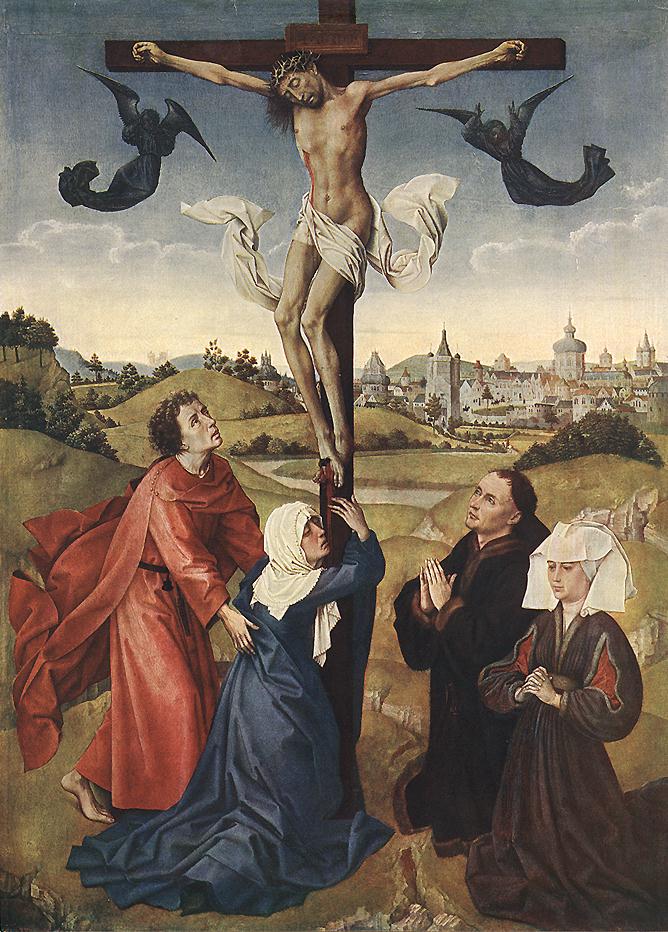
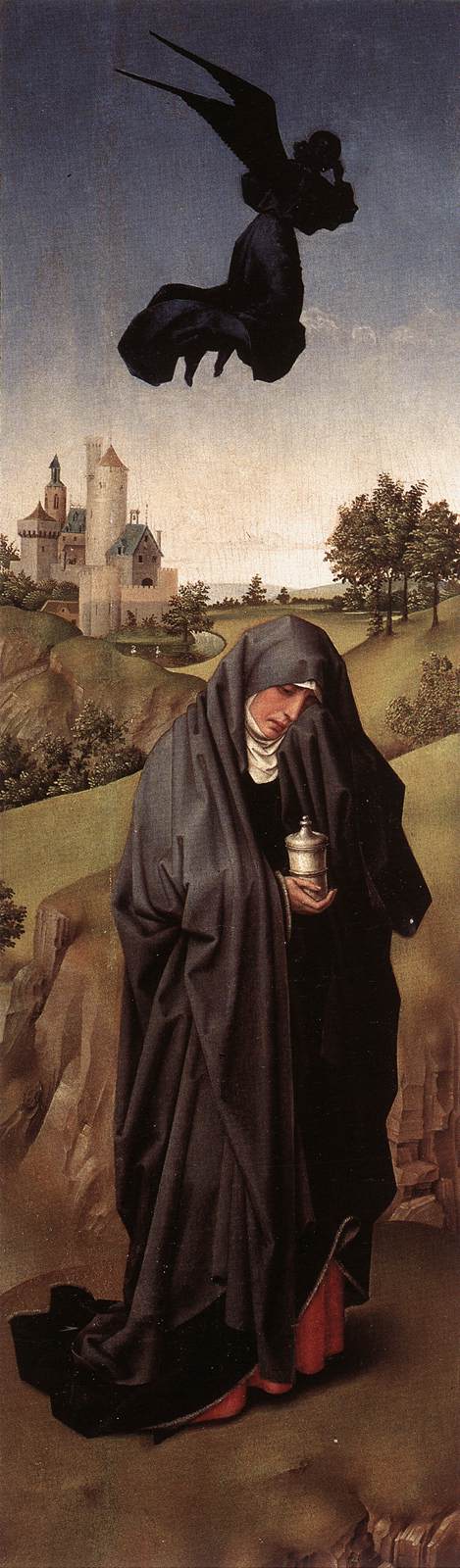

by Rogier van der WEYDEN
From Web Gallery of Art:
From Web Gallery of Art:
The Crucifixion Triptych, like the Seven Sacraments Altarpiece, is impressive in its composition. The two are linked not only by the use of a painted golden frame structure in the picture (not found, or not yet found, in any other surviving works by Rogier), but also in the style of the underdrawing. Both works may have been created at roughly the same time, and the dating of the triptych to around 1445, on dendrochronological evidence, would support that theory. Certainly the designs of both pictures derive from Rogier himself, but his assistants seem to have been involved in the execution, and perhaps did some of the preparatory underdrawing as well. The figures of the triptych are executed to a very high standard.Crucifixion Triptych (central panel)
Crucifixion Triptych
(left wing)
(left wing)
Crucifixion Triptych (right wing)
Monday, March 23, 2009
Ecce Homo
 Antonio Ciseri (1821-91)
The scene - The Praetorium, Jerusalem, 30CE"Behold the man,"
The Governor, Pontius Pilate. (John 19.5)
John 19
1 Then therefore, Pilate took Jesus, and scourged him. 2 And the soldiers platting a crown of thorns, put it upon his head; and they put on him a purple garment. 3 And they came to him, and said: Hail, king of the Jews; and they gave him blows. 4 Pilate therefore went forth again, and saith to them: Behold, I bring him forth unto you, that you may know that I find no cause in him. 5 (Jesus therefore came forth, bearing the crown of thorns and the purple garment.) And he saith to them: Behold the Man.
Monday, March 16, 2009

Friday, March 13, 2009
The Scourging
 "Christ after the Flagellation," by Diego Velazquez
Velazquez's Jesus is scourged, yet serene: The Spanish artist depicts the soul contemplating Christ -
Sr. Wendy Beckett's interpretation.
Sr. Wendy Beckett's interpretation.
Wednesday, March 4, 2009
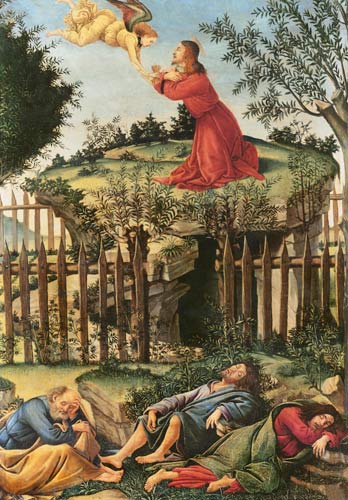

Luke 22:39-51
39 And going out, he went, according to his custom, to the mount of Olives. And his disciples also followed him. 40 And when he was come to the place, he said to them: Pray, lest ye enter into temptation.41 And he was withdrawn away from them a stone's cast; and kneeling down, he prayed, 42 Saying: Father, if thou wilt, remove this chalice from me: but yet not my will, but thine be done. 43 And there appeared to him an angel from heaven, strengthening him. And being in an agony, he prayed the longer. 44 And his sweat became as drops of blood, trickling down upon the ground. 45 And when he rose up from prayer, and was come to his disciples, he found them sleeping for sorrow.
46 And he said to them: Why sleep you? arise, pray, lest you enter into temptation. 47 As he was yet speaking, behold a multitude; and he that was called Judas, one of the twelve, went before them, and drew near to Jesus, for to kiss him. 48 And Jesus said to him: Judas, dost thou betray the Son of man with a kiss? 49 And they that were about him, seeing what would follow, said to him: Lord, shall we strike with the sword? 50 And one of them struck the servant of the high priest, and cut off his right ear.
51 But Jesus answering, said: Suffer ye thus far. And when he had touched his ear, he healed him.
Thursday, January 1, 2009
THE MOTHER

Thanks to Karen for this great post and for the link to the above article (here) by Romano Guardinion on the faith of Mary.
Monday, September 29, 2008

Our October art study will center around knowing, loving, and serving God. What better example to put forth than St. Bernard, so we will be studying the above print by Italian painter Filippino Lippi, along with a couple of other prints I have around the house. This print is titled "Apparation of the Virgin to St. Bernard". We begin with a look at the detail art print of the angels found in CHC's Art Masterpieces and will move out to examine the print as a whole.

Wednesday, June 18, 2008
CHRISTIANITY'S FIRST CATHEDRAL
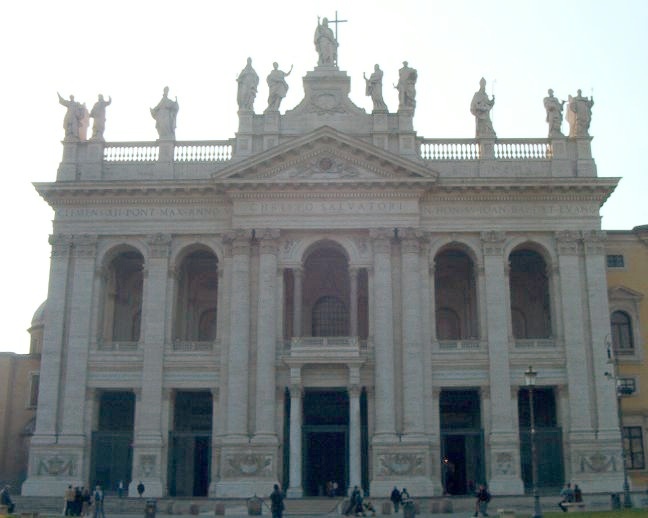 St. John Lateran is the oldest and most highest ranking basilica in Rome. It is the cathedral of Rome - the official seat of the Pope. It is dedicated to Our Saviour, St. John the Baptist, and St. John the Evangelist. On the front of the building is an inscription stating that this is "SACROSANCTA LATERANENSIS ECCLESIA OMNIUM URBIS ET ORBIS ECCLESIARUM MATER ET CAPUT" translated as "The Most Holy Lateran Church, Mother and Mistress of all churches of the city and the World". It is also known the Basilica Aurea, "The Golden Basilica", due to the magnificant decorations which adore it.
From Wikia:
The main façade is the work of Alessandro Galilei, from 1736. The first stone was laid by Pope Clement XII on 8 December, 1735. It has five large arches opening on the narthex, and is crowned by c. 7 metre high statues of Christ, Sts John the Baptist and John the Evangelist and other saints. The full list of the large statues, with the artists' names, is:
- Jesus Christ by P. Benaglia
- St John the Baptist by B. Pincellotti
- St John the Evangelist by D. Scaramuccia
- St Gregory the Great by Giovanni Battista de Rossi
- St Jerome by A. Corsini
- St Ambrose by A. Benaglia
- St Augustine by B. Ludovisi
- St Athanasius by P. l'Eastache
- St Basil by G. Riccardi
- St John Chrysostom by G. Frascari
- St Gregory Nazianz by C. Taodardini
- St Bernard by T. Brandini
- St Thomas Aquinas by P. Latour
- St Bonaventure by B. Casoni
- St Eusebius Vercelli by G.F. Lazzoni
The Loggia of Blessings is in the centre. From it, a newly elected Pope gives his blessing on the day that he first takes possession of the cathedral.
The façade faces the east, as the basilica was built before the tradition of placing the altar in the east had taken hold in Rome.

This is the "papal altar" - not because only the pope uses it - but because it contains a wooden altar used by St. Peter and the early Popes. The relics of the heads of Sts. Peter and Paul are behind the grill above the altar.
Another altar, The Altar of the Blessed Sacrament, made by Pier Paolo Olivieri enshrines a table traditionally said to be that used by Christ at the Last Supper. The columns of this altar are made of bronze and marble, and are thought to have come from the columns of Cleopatra's ships.
It is an ancient tradition in Rome to have station churches . The faithful visit these various churches during the 40 days of Lent (and throughout the liturgical year) for the celebration of Mass and reciting of the Litany of the Saints.
St. John Lateran is visited 3 times during Lent (see here for more info on this practice).
For more on this beautiful church in addtion to the above links, see www.romanchurches and New Advent .
Thursday, May 29, 2008
St. Peter's Basilica
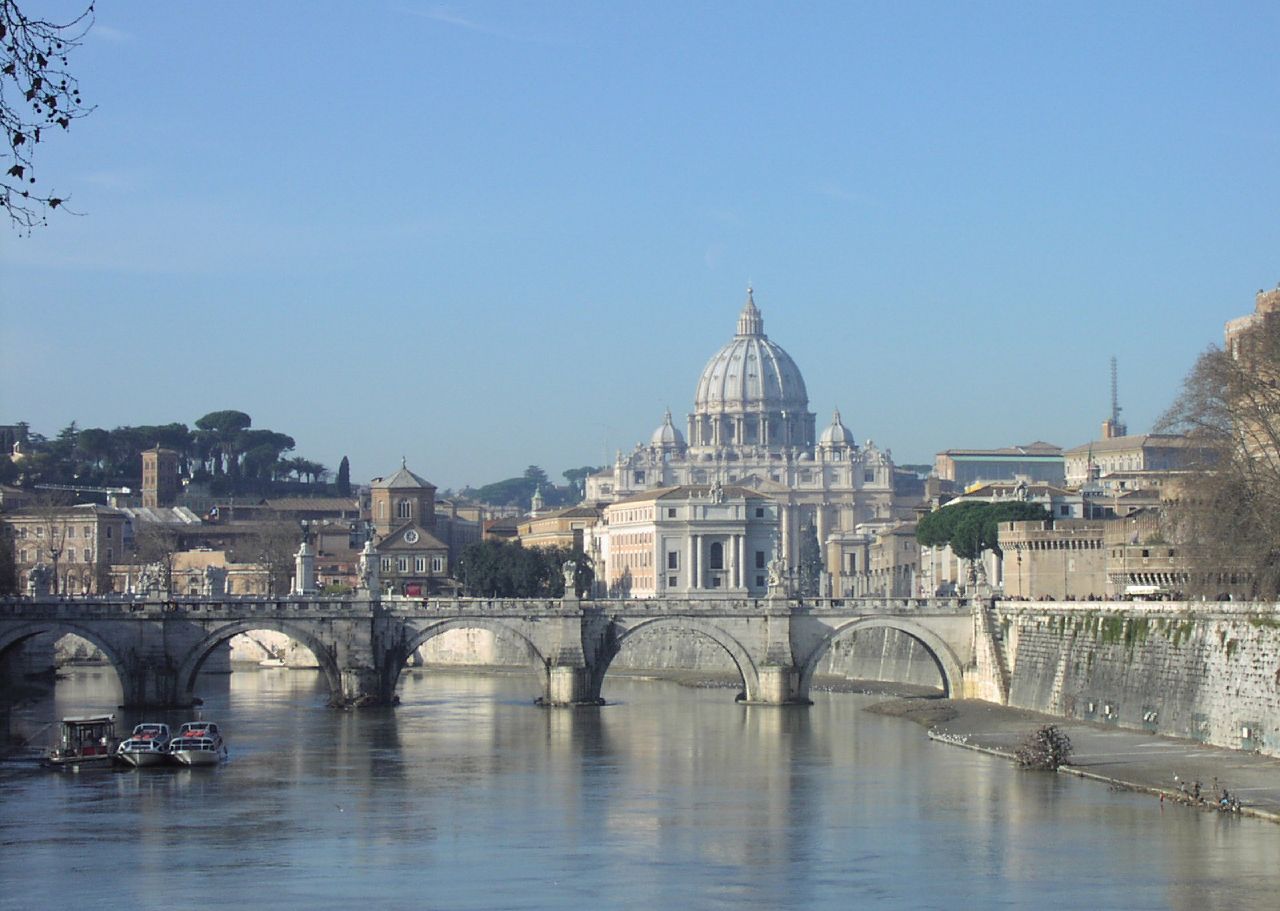 St. Peter's Basilica from the River Tiber. The iconic dome dominates the skyline of Rome.
Our art study will include a look at Vatican City and the four major basilicas. The first is St. Peter's Basilica. Remember that St. Peter's is not a cathedral because it is not the seat of a bishop as that is reserved for Basilica of St. John Lateran. But many, if not most, of papal activities occur here.
 The dome, designed by Michelangelo, is one of the most recognizable features of St. Peter's. The interior can be seen here.
The Chair of Peter is a wooden chair enclosed in a gilt bronze casing designed by Gian Lorenzo Bernini. The chair of a bishop is a cathedra. Tradition holds that this chair was used by St. Peter himself.

The Cathedra Petri, seen from
behind the High Altar of St. Peter's
The dome, designed by Michelangelo, is one of the most recognizable features of St. Peter's. The interior can be seen here.The Chair of Peter is a wooden chair enclosed in a gilt bronze casing designed by Gian Lorenzo Bernini. The chair of a bishop is a cathedra. Tradition holds that this chair was used by St. Peter himself.

The Cathedra Petri, seen from
Sunday, May 25, 2008
Corpus Christi Sequence and Artwork
The painting is The Institution of the Eucharist by the Flemish artist
Joos van Wassenhove, c.1474
Joos van Wassenhove, c.1474
 And he took bread, gave thanks and broke it, and gave it to them, saying, “This is my body given for you; do this in remembrance of me.” Luke 22:19
From the Latin Mass Society of England and Wales:
SEQUENCE : LAUDA SION
On certain days the Church wished to prolong the joy of the Alleluia, or the sorrow and penance expressed in the verses of the Tract which sometimes replaces it, and so a hymn or psalm called the Sequence was added. There are five Sequences in the 1962 Missal which are as follows :
Victimae Paschali for Easter Sunday thought to have been composed about 1048;
Veni Sancte Spiritu for Pentecost, to Pope Innocent III about 1198;
Lauda Sion for Corpus Christ composed by St Thomas Aquinas about 1274;
Stabat Mater for the Feast of the Sorrowful Mother composed about 1306;
Dies Irae in Masses for the Dead (Missae Defunctorum) composed about 1250.
These Sequences, hallowed by centuries of continued use, abound in poetic beauty and doctrinal orthodoxy, as we can see from reading the incomparable Lauda Sion reproduced in full below. Their disappearance from the liturgy of the Mass is a loss to the Church which has never been made good. For many Catholics today the
Click here to read this beautiful sequence by
St. Thomas Aquinas for the Feast of Corpus Christi.
Wednesday, May 21, 2008
Botticelli

The Madonna of the Book, also known as the Madonna del Libro, is a small painting by the Italian Renaissance artist Sandro Botticelli, circa 1483. It is housed in the Museo Poldi Pezzoli of Milan.
I simply love this artist and will have a very hard time presenting only one of his works this upcoming school year. CHC's Liturgical Masterpieces has Madonna with the Child (Madonna with the Book) scheduled to be studied in January.
This print is beside my dresser in my bedroom.

Virgin and Child with Four Angels and Six Saints
(San Barnabas altarpiece). c.1487.
"A Virgin became the Mother of God, in order to reconcile man with God, to give peace to the world, triumph to Heaven, salvation to mankind, and life to the dead." St. Augustine
Monday, May 12, 2008
The Angelus
 This is one of my favorites!
The Angelus is a prayer rich in doctrine and devotion. It commemorates the mystery of the Incarnation by reciting certain versicles and responses with three Hail Marys and a special concluding prayer. It is recited morning, noon and evening. The church bells ring--three tolls for each of the invocations and nine for the concluding prayer.
The renowned painting by Jean-Francois Millet entitled the Angelus depicts a man and a woman standing in a field. They are farmers. He holds his cap reverently as he stands with bowed head, and she in a white cap and long blue apron over her dress clasps her hands as a prayerful look sets her face. They pause in prayer near the end of the work day.
Art Appreciation

As I prepare my class plans for beginning school in the Fall, I am checking out some Catholic art that we will be studying. So I thought it would be cool to include some pictures and link to information about it and/or the artist.
The first one is The Coronation of the Blessed Virgin Mary by Guido Reni.
I hope everyone enjoys the postings.
Subscribe to:
Posts (Atom)