Showing posts with label Liturgical. Show all posts

Wednesday, October 5, 2011

Prayer Request from the SSPX

10-4-2011

As announced by DICI, the Superior General, Bishop Fellay, has called all of the SSPX's superiors to a special meeting at the Society's house in Albano, near Rome.

This meeting is important for the future of the entire Church, and because its main session will take place on October 7th (the Feast of Our Lady of the Rosary), the United States District Superior, Fr. Rostand, is requesting special prayers to the Blessed Virgin Mary on this day through recitation of all 15 decades of the Rosary.

As this day will also happen to be the First Friday for October, Fr. Rostand encourages all who can to spiritually assist the SSPX by fulfilling that day's devotions to the Sacred Heart—attendance at the votive Mass and adoration of the Blessed Sacrament.

Tuesday, September 22, 2009

Reminder: Ember Days

This Wednesday, Friday, and Saturday are traditional (according to the 1962 calendar) Ember Days. Although the practice is not required by the US bishops, it is with generosity we can offer these small sacrifices (fasting and partial abstinence) in reparation for the many outrages going on in the world today.

Some notes on the Ember Days:

The purpose of their introduction, besides the general one intended by all prayer and fasting, was to thank God for the gifts of nature, to teach men to make use of them in moderation, and to assist the needy.

There are four sets of Ember Days each calendar year; three days each – Wednesday, Friday, and Saturday. Ember Days fall at the start of a new season and they were ordered as days of fast and abstinence. The significance of the days of the week are that Wednesday was the day Christ was betrayed, Friday was the day He was crucified, and Saturday was the day He was entombed.

Ember Days were marked by fasting and partial abstinence from meat. Fasting allows one full meal a day, but does not prohibit taking some food in the morning and evening. The normal rule of thumb is that the two smaller meals should not equal one full meal. Eating between meals is not allowed, but liquids are allowed. Partial abstinence allows meat to be eaten at the principal meal.

More info here

Saturday, May 9, 2009

SSPX Ordinations in France

Pictures from the SSPX's ordination at the
Church of the Benedictine Monastery of
Our Lady of Bellaigue in France can be found
here. They are absolutely beautiful!


Wednesday, March 25, 2009

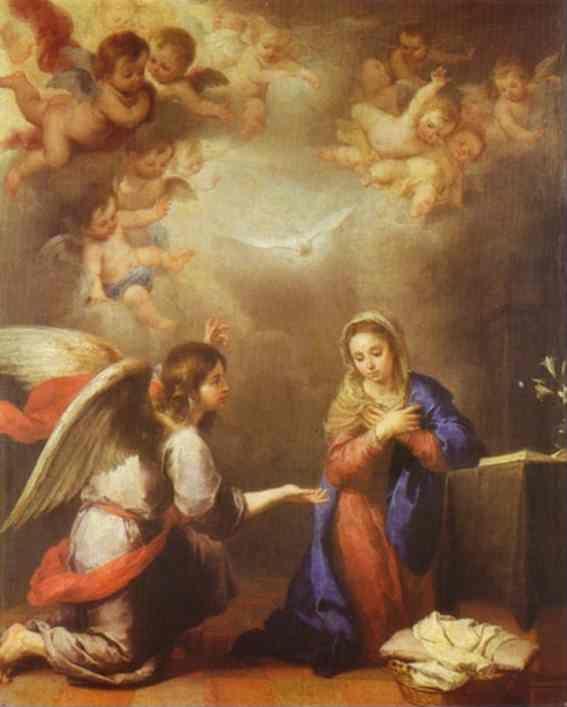
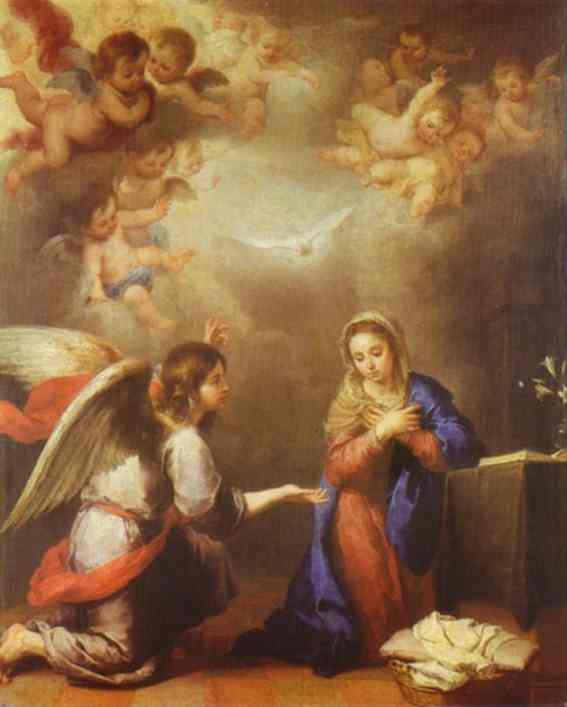
Meditation on the Annunciation


Bartolomo Esteban Murillo. Annunciation.
c.1660-65. Oil on canvas. Museo del Prado, Madrid, Spain. (Source)

A nice meditation on today's feast over at America Needs Fatima blog . . .
and also at Happy Catholic.

Luke 1: 26-35

26 And in the sixth month, the angel Gabriel was sent from God into a city of Galilee, called Nazareth, 27 To a virgin espoused to a man whose name was Joseph, of the house of David; and the virgin's name was Mary. 28 And the angel being come in, said unto her: Hail, full of grace, the Lord is with thee: blessed art thou among women. 29 Who having heard, was troubled at his saying, and thought with herself what manner of salutation this should be. 30 And the angel said to her: Fear not, Mary, for thou hast found grace with God.

31 Behold thou shalt conceive in thy womb, and shalt bring forth a son; and thou shalt call his name Jesus. 32 He shall be great, and shall be called the Son of the most High; and the Lord God shall give unto him the throne of David his father; and he shall reign in the house of Jacob for ever. 33 And of his kingdom there shall be no end. 34 And Mary said to the angel: How shall this be done, because I know not man? 35 And the angel answering, said to her: The Holy Ghost shall come upon thee, and the power of the most High shall overshadow thee. And therefore also the Holy which shall be born of thee shall be called the Son of God.


Tuesday, March 10, 2009

Novena to St. Joseph

March is the month traditionally dedicated to St. Joseph. One of his feast days is on March 19. To honor St. Joseph, I will be join Totus Tuus in beginnning today a novena to this great saint who exemplifies so many of the qualities I lack . . . Please join us, too!
Glorious St. Joseph, model of all who are devoted to labor, obtain for me the grace to work in the spirit of penance in expiation of my many sins; to work conscientiously by placing love of duty above my inclinations; to gratefully and joyously deem it an honor to employ and to develop by labor the gifts I have received from God, to work methodically, peacefully, and in moderation and patience, without ever shrinking from it through weariness or difficulty to work; above all, with purity of intention and unselfishness, having unceasingly before my eyes death and the account I have to render of time lost, talents unused, good not done, and vain complacency in success, so baneful to the work of God. All for Jesus, all for Mary, all to imitate thee, O patriarch St. Joseph! This shall be my motto for life and eternity.

Wednesday, January 21, 2009

A Big Surpirse? Who's Surprised . . .

I don't know why people are saying "big surprise coming". We prayed over a million rosaries, twice. The first time our prayers were answered, so why would we be surprised if Our Lady answered again?

Some very interesting posts from Fr. Demet:

Removal of the excommunications
A Guide

Also the following:


Wednesday, January 21, 2009

A surprise - for tomorrow
Updated: more confirmations

The extremely well-informed Spanish blogger Francisco José Fernández de la Cigoña (whose blog La Cigüeña de la Torre was, for instance, one of the first to predict the nomination of Cardinal Cañizares Llovera as Prefect of CDW) had hinted on the nature of the "explosive news" since last week - and since November, in fact.
Today, he confirms that his sources report "explosive news" related to the "Lefebvrists" [sic] - probably the removal or withdrawal of the excommunications of the four Bishops of the Priestly Fraternity of Saint Pius X (FSSPX / SSPX), consecrated by Archbishop Marcel Lefebvre and co-consecrated by Bishop Antonio de Castro Mayer in Ecône, Switzerland, on June 30, 1988. Fernández de la Cigoña predicts the Papal act for "tomorrow" (though it is unclear how long it will take for the act to be made public).
The other signs that things are on the move were reported here yesterday.
__________________

UPDATE (2248 GMT). Italian religious journalist Andrea Tornielli has just confirmed in his blog the increasing reports: the Pope has already signed the withdrawal of excommunications, and his act will be made public in the next few days.


Thursday, January 1, 2009

THE MOTHER


Thanks to Karen for this great post and for the link to the above article (here) by Romano Guardinion on the faith of Mary.

Tuesday, December 16, 2008

O Antiphons


Don't forget the O Antiphons begin tomorrow. For an explanation of these, see the Fish Eaters entry here. Also, for ideas of how to celebrate this time in the Liturgical Year, O Night Divine blog is an excellent resource!
Catholic Culture has several ideas, here and here.

The "O Antiphons"

December 17
O Wisdom, Who didst come out of the mouth of the Most High, reaching from end to end and ordering all things mightily and sweetly: come and teach us the way of prudence.

December 18
O Adonai, and Leader of the house of Israel, Who didst appear to Moses in the flame of the burning bush, and didst give unto him the Law on Sinai: come and with an outstretched arm redeem us.

December 19
O Root of Jesse, Who dost stand for an ensign of the people, before Whom kings shall keep silence, and unto Whom the Gentiles shall make their supplication: come to deliver us, and tarry not.

December 20
O Key of David and Sceptre of the house of Israel, Who dost open and no man doth shut, Who dost shut and no man doth open, come and bring forth from his prison-house the captive that sitteth in darkness and in the shadow of death.

December 21
O Dawn of the East, Brightness of the Light Eternal and Sun of Justice, come and enlighten them that sit in darkness and in the shadow of death.

December 22
O King of the Gentiles and the Desired of them, Thou Cornerstone that dost make both one, come and deliver man, whom Thou didst form out of the dust of the earth.

December 23
O Emmanuel, our King and Lawgiver, the Expected of the Nations and their Saviour, come to save us, O Lord our God.

Sunday, November 30, 2008

St. Andrew Novena begins today!

The St. Andrew Novena begins today. It is piously believed that whoever recites this prayer fifteen times a day from the feast of St. Andrew (30th November) until Christmas will obtain what is asked.

"Hail and blessed be the hour and moment in which the Son of God was born of the most pure Virgin Mary, at midnight, in Bethlehem, in piercing cold. In that hour, vouchsafe, O my God! to hear my prayer and grant my desires, through the merits of Our Saviour Jesus Christ, and of His Blessed Mother. Amen."


Imprimatur
+MICHAEL AUGUSTINE, Archbishop of New York
New York, February 6, 1897

Tuesday, November 25, 2008

Reception of the Holy Eucharist

An excellent read from an interview with Archbishop Raymond Burke who was appointed by the Holy Father to serve as the Prefect of the Apostolic Signatura. The Supreme Tribunal of the Apostolic Signatura is the administrative appellate tribunal of the Holy See and, consequently, the highest judicial authority of the Catholic Church besides the Pope himself.

The Holy Eucharist: A Right or a Gift?
Examining the pastoral aspects of Canon 915 and respect for the Holy Eucharist.
Interview by Thomas J. McKenna
Catholic Action for Faith and Family
August 2008

Here are a couple of "teasers" to peak your interest (my emphasis added):
These would just be some of the elements which I think have entered in and explain the lax attitude toward the Holy Eucharist, in general. We see this even in the way people dress for participation in Mass. For example, we see during Mass people going up to receive Holy Communion not folding their hands and even sometimes visiting with others along the way. Some, even at the time they are actually receiving Holy Communion, do not show the proper reverence. All of these are indications of the need of a new evangelization regarding Eucharistic faith and practice.
and, one of the questions posed to Archbishop Burke:
Some people say that it is a right to receive Holy Communion and that no one else hasthe right to tell another not to receive the Sacrament. Not even a bishop, priest or minister. What would you respond to them?
Seems a note-worthy question for recent events . . . so go and read the full article!


Thursday, November 20, 2008

South Carolina Priest Had Support Originally (then there is that tax-exempt thing that seems to get in the way)

A very interesting story about the Administrator of Charleston's initial response to Fr. Newman was one of praise . . . HERE
Something that was interesting to me was this quote from the article:
As an exclusive, I have attached below a letter sent out by Msgr. Laughlin in October gravely warning priests against presenting anything from the pulpit that could be interpreted by the IRS as threatening the Church’s tax exempt status.
Please read the article to get the full story.

Tuesday, November 18, 2008

Fr. Newman and the Church's Stand

As you all can tell from my lack of posts, I do not have much time to spend here, but feel like this is too important to only link to from my Google Reader.
A scandal (my perception) has resulted from a South Carolinian priest's request (note that I had to use an external source since the Diocese has removed it from the parish's website) and the Administrator of the Diocese's reply.
Barbara Kralis does an excellent job of presenting Fr. Newman's justification for his announcement and causing us all to ask, "What in the world is this Administrator thinking". Her article is posted on RenewAmerica. You can find her entire article in two parts here1 and here2.

Some excerpts:

Solemn and Ordinary Magisterial Teachings

  • "The Church stresses that a well-formed Christian conscience does not permit one to vote for a political program or an individual law which contradicts the fundamental contents of faith and morals.... John Paul II, continuing the constant teaching of the Church, has reiterated many times that those who are directly involved in lawmaking bodies have a 'grave and clear obligation to oppose' any law that attacks human life.

    "For them, as for every Catholic, it is impossible to promote such laws or to vote for them" [1]

  • "Presenting oneself to receive Holy Communion should be a conscious decision, based on a reasoned judgment regarding one's worthiness to do so, according to the Church's objective criteria, asking such questions as: 'Am I in full communion with the Catholic Church? Am I guilty of grave sin? Have I incurred a penalty [e.g. excommunication, interdict] that forbids me to receive Holy Communion? Have I prepared myself by fasting for at least an hour?' The practice of indiscriminately presenting oneself to receive Holy Communion, merely as a consequence of being present at Mass, is an abuse that must be corrected." [2]

  • "If we tell ourselves that the Church ought not to interfere in such matters, we cannot but answer: are we not concerned with the human being? Do not believers, by virtue of the great culture of their faith, have the right to make a pronouncement on all this? Is it not our duty to raise our voices to defend the human being, that creature who, precisely in the inseparable unity of body and spirit, is the image of God?" [3]

  • "Among all the crimes which can be committed against life, procured abortion has characteristics making it particularly serious and deplorable" [Pope John Paul II, 'Evangelium vitae,' n.58].

  • In treating the evil of procured abortion, Pope John Paul II concluded: "No circumstance, no purpose, no law whatsoever can ever make licit an act which is intrinsically illicit, since it is contrary to the Law of God which is written in every human heart, knowable by reason itself, and proclaimed by the Church" [Pope John Paul II, 'Evangelium vitae,' n.62d].

  • "Laws, which authorize and promote abortion... [are] radically opposed not only to the good of the individual but also to the common good; as such they are completely lacking in authentic juridical validity. Disregard for the right to life, precisely because it leads to the killing of the person whom society exists to serve, is what most directly conflicts with the possibility of achieving the common good. Consequently, a civil law authorizing abortion or euthanasia ceases by that very fact to be a true, morally binding civil law. [Pope John Paul II, 'Evangelium vitae,' n.72].

  • "To claim the right to abortion, infanticide and euthanasia, and to recognize that right in law, means to attribute to human freedom a perverse and evil significance: that of an absolute power over others and against others. This is the death of true freedom: 'Truly, truly, I say to you, every one who commits sin is a slave to sin'" Jn 8:34 [Pope John Paul II, 'Evangelium vitae,' n.20].

  • "The Church's custom shows that it is necessary for each person to examine himself at depth, and that anyone who is conscious of grave sin should not celebrate or receive the Body of the Lord without prior sacramental confession, except for grave reason when the possibility of confession is lacking; in this case he will remember that he is bound by the obligation of making an act of perfect contrition, which includes the intention to confess as soon as possible. Moreover, the Church has drawn up norms aimed at fostering the frequent and fruitful access of the faithful to the Eucharistic table and at determining the objective conditions under which Communion may not be given [Ecclesia de Eucharistia n. 42]. It is certainly best that all who are participating in the celebration of Holy Mass with the necessary dispositions should receive Communion. Nevertheless, it sometimes happens that Christ's faithful approach the altar as a group indiscriminately.

    "It pertains to the Pastors prudently and firmly to correct such an abuse." [4]

  • "Abortion and euthanasia are thus crimes which no human law can claim to legitimize. There is no obligation in conscience to obey such laws; instead there is a grave and clear obligation to oppose them by conscientious objection. From the very beginnings of the Church, the apostolic preaching reminded Christians of their duty to obey legitimately constituted public authorities [cf. Rom 13:1-7; 1 Pet 2:13-14], but at the same time it firmly warned that 'we must obey God rather than men' [Acts 5:29]. ... It is precisely from obedience to God -to whom alone is due that fear which is acknowledgment of his absolute sovereignty — that the strength and the courage to resist unjust human laws are born. It is the strength and the courage of those prepared even to be imprisoned or put to the sword, in the certainty that this is what makes for 'the endurance and faith of the saints' [Rev 13:10].
  • Wednesday, November 5, 2008

    Post Election Thoughts

    OK, it is over and the pro-abortion candidate won. I have thought about a rant I would like to go on, but am resigned to God's Will. We prayed, we sacrificed, we hoped . . . and the majority of voters chose Obama. I believe God sends us tests, just as He tested the Angels and Adam and Eve. Sometimes it may be little tests of our faith or our obedience, and sometimes there are bigger stakes. I believe that we failed this test and I also believe there will be a sentence. That said, I will pray for our future president and all our leaders just as I pray for the present.
    Now, can someone please explain the following article to me. I heard it from the SSPX pulpit, and the bishops of North Carolina "ordered" a statement to be read at Masses, as did many bishops throughout the United States. So why did such a large percentage of Catholics vote for Obama? Excuse me, but I am labeled the "disobedient" one for attending SSPX Masses . . . ????????????
    From the Catholic News Service:
    Catholic voters mirror general electorate in support for Obama

    WASHINGTON (CNS) -- Catholics pretty much voted the way the rest of the country did in supporting Democratic Sen. Barack Obama in the presidential race Nov. 4, according to some early poll reports. Exit poll data was still being compiled and analyzed Nov. 5, but early information showed 53 percent or 54 percent of Catholics supported Obama and 44 percent or 45 percent were for Republican Sen. John McCain. Of the total population, 52 percent of Americans voted for Obama and 46 percent for McCain. By comparison, 52 percent of Catholics in 2004 supported Republican President George W. Bush and 47 percent voted for Democratic Sen. John Kerry. The total nationwide vote in 2004 was 55 percent for Bush and 44 percent for Kerry. Final pre-election polls from battleground states showed there would likely be some differences between the Catholic vote and the overall vote in those states, however.

    Saturday, September 27, 2008

    Next Week's Liturgical Year

    As I plan my school week next week (yes, I only do one week at a time as I am never sure what I will get done or what tangents we may take off on), I am so excited about the upcoming feast days. While each week offers a chance to appreciate the year that the Catholic Church brings to us through its liturgical calendar, next week will be extra special to a certain 5-year old who has his favorite saints. We may be partying all week instead of schooling!
    We begin with St. Wenceslaus on Sunday. We will take this day to imitate the saint by giving - going through our toys and clothes to find appropriate ones to donate to those in need - not just the ones we do not want, but also some of our favorites so there is a real sacrifice. Also, we will remember his service to the poor when we deliver meals to the elderly on Mondays. See here for the story of this saint.
    On Monday comes a namesake. Michael looks forward to the great feast of his namesake, the Dedication of St. Michael the Archangel. Here is a link to a coloring page from Waltzing Maltida's blog, and since one of his many titles is patron saint of baker's, we will bake a special cake for the dinner celebration in additon to our special waffles for breakfast. I suspect a re-enactment of the battle of the good angels and the bad angels will definitely be on the schedule.
    Tuesday's saint is St. Jerome, and we will read St. Jerome and the Lion for fun, but also focus on his great contribution to translating the bible.
    Wednesday is the feast day of a saint we have not studied, St. Remigius. We will read his story and briefly study Reims, France with a look at the famous Gothic cathedral, the Cathedral of Our Lady of Reims.
    The Holy Guardian Angels feast day is on Thursday. Again, I am sure there will be a reenactment of the Fall of the Bad Angels. We will pay extra attention to our own guardian angel by making sure we have an extra table setting for each family member beside him during meals and a special art project, yet to be determined. And of course, there is the Angel Food cake with fresh strawberries!
    Friday brings our favorite saint to read about. St. Therese of the Child Jesus has a natural appeal to all young children because of her simplicity. We will read several of our stories about St. Therese's life along with making sacrifice beads and hopefully, make some potpourri.
    Lastly, on Saturday is another namesake, St. Francis of Assisi. A short study of the Basillica of St. Francis will be included and hopefully, we will be able to take at the least our dog, for a blessing. This may have to be done by dad. Hopefully, we will get the story, St. Francis and the Wolf of Gubbio, read. Our parish put this play on a couple of years ago and Michael really enjoyed it.
    Well, that is a start to my layout for next week. I have not included activities from CHC's A Year with God or Mary Reed Newland's The Year and Our Children, which I use alot as resources. But these will be incorporated into my plans, more than likely, very late tonight!

    Friday, September 12, 2008

    More Pius X

    Following up on my last post, here are some excerpts from Pascendi Dominici Gregis (On the Doctrine of the Modernist). Please note that these words come from the only Pope to be canonized in the twentieth century! Again, look at the foresight of this pope. I heard recently that he is the least often quoted pope today - I wonder why??? Note highlights are mine.

    28. Thus then, Venerable Brethren, for the Modernists, both as authors and propagandists, there is to be nothing stable, nothing immutable in the Church. Nor indeed are they without precursors in their doctrines, for it was of these that Our Predecessor Pius IX wrote: These enemies of divine revelation extol human progress to the skies, and with rash and sacrilegious daring would have it introduced into the Catholic religion as if this religion were not the work of God but of man, or some kind of philosophical discovery susceptible of perfection by human efforts. On the subject of revelation and dogma in particular, the doctrine of the Modernists offers nothing new - we find it condemned in the Syllabus of Pius IX., where it is enunciated in these terms: Divine revelation is imperfect, and therefore subject to continual and indefinite progress, corresponding with the progress of human reason; and condemned still more solemnly in the Vatican Council: The doctrine of the faith which God has revealed has not been proposed to human intelligences to be perfected by them as if it were a philosophical system, but as a divine deposit entrusted to the Spouse of Christ to be faithfully guarded and infallibly interpreted. Hence the sense, too, of the sacred dogmas is that which our Holy Mother the Church has once declared, nor is this sense ever to be abandoned on plea or pretext of a more profound comprehension of the truth. Nor is the development of our knowledge, even concerning the faith, impeded by this pronouncement - on the contrary it is aided and promoted. For the same Council continues: Let intelligence and science and wisdom, therefore, increase and progress abundantly and vigorously in individuals and in the mass, in the believer and in the whole Church, throughout the ages and the centuries - but only in its own kind, that is, according to the same dogma, the same sense, the same acceptation.
    42. . . . The Modernists pass judgment on the holy Fathers of the Church even as they do upon tradition. With consummate temerity they assure the public that the Fathers, while personally most worthy of all veneration, were entirely ignorant of history and criticism, for which they are only excusable on account of the time in which they lived. Finally, the Modernists try in every way to diminish and weaken the authority of the ecclesiastical magisterium itself by sacrilegiously falsifying its origin, character, and rights, and by freely repeating the calumnies of its adversaries. To the entire band of Modernists may be applied those words which Our predecessor sorrowfully wrote: "To bring contempt and odium on the mystic Spouse of Christ, who is the true light, the children of darkness have been wont to cast in her face before the world a stupid calumny, and perverting the meaning and force of things and words, to depict her as the friend of darkness and ignorance, and the enemy of light, science, and progress.''[23] This being so, Venerable Brethren, there is little reason to wonder that the Modernists vent all their bitterness and hatred on Catholics who zealously fight the battles of the Church. There is no species of insult which they do not heap upon them, but their usual course is to charge them with ignorance or obstinacy. When an adversary rises up against them with an erudition and force that renders them redoubtable, they seek to make a conspiracy of silence around him to nullify the effects of his attack. This policy towards Catholics is the more invidious in that they belaud with admiration which knows no bounds the writers who range themselves on their side, hailing their works, exuding novelty in every page, with a chorus of applause. For them the scholarship of a writer is in direct proportion to the recklessness of his attacks on antiquity, and of his efforts to undermine tradition and the ecclesiastical magisterium. When one of their number falls under the condemnations of the Church the rest of them, to the disgust of good Catholics, gather round him, loudly and publicly applaud him, and hold him up in veneration as almost a martyr for truth. The young, excited and confused by all this clamor of praise and abuse, some of them afraid of being branded as ignorant, others ambitious to rank among the learned, and both classes goaded internally by curiosity and pride, not infrequently surrender and give themselves up to Modernism.


    Monday, September 8, 2008

    St. Pius X

    I did not have time last week to recognize St. Pius X's feastday here, so I now post one of his greatest Encyclicals, the Syllabus condemning the modernists. Please read the list of errors and look at the state of many of our Catholic parishes today. What foresight this great Saint had and how his words are forgotten today!
    Saint Pius X, pray for us!

    From Papal Encyclicals Online :

    Lamentabili Sane

    (Condemning the Errors of the Modernists)
    Sacred Congregation of the Holy Office
    July 3, 1907

    WITH TRULY LAMENTABLE RESULTS, our age, casting aside all restraint in its search for the ultimate causes of things, frequently pursues novelties so ardently that it rejects the legacy of the human race. Thus it falls into very serious errors, which are even more serious when they concern sacred authority, the interpretation of Sacred Scripture, and the principal mysteries of Faith. The fact that many Catholic writers also go beyond the limits determined by the Fathers and the Church herself is extremely regrettable. In the name of higher knowledge and historical research, (they say), they are looking for that progress of dogmas which is, in reality, nothing but the corruption of dogmas.

    These errors are being daily spread among the faithful. Lest they captivate the faithful's minds and corrupt the purity of their faith, His Holiness, Pius X, by Divine Providence, Pope, has decided that the chief errors should be noted and condemned by the Office of this Holy Roman and Universal Congregation.

    Therefore, after a very diligent investigation and consultation with the Reverend Consultors, the Most Eminent and Reverend Lord Cardinals, the General Inquisitors in matters of faith and morals have judged the following proposals to be condemned and proscribed. In fact, by this current decree, they are condemned and proscribed.

    1. The ecclesiastical law which prescribes that books concerning the Divine Scriptures are subject to previous examination does not apply to critical scholars and students of scientific exegesis of the Old and New Testament.
    2. The Church's interpretation of the Sacred Books is by no means to be rejected; nevertheless, it is subject to the more accurate judgment and correction of the exegetes.
    3. From the ecclesiastical judgments and censures passed against free and more scientific exegesis, one can conclude that the Faith the Church proposes contradicts history and that Catholic teaching cannot really be reconciled with the true origins of the Christian religion.
    4. Even by dogmatic definitions the Church's magisterium cannot determine the genuine sense of the Sacred Scriptures.
    5. Since the Deposit of Faith contains only revealed truths, the Church has no right to pass judgment on the assertions of the human sciences.
    6. The "Church learning" and the "Church teaching" collaborate in such a way in defining truths that it only remains for the "Church teaching" to sanction the opinions of the "Church learning."
    7. In proscribing errors, the Church cannot demand any internal assent from the faithful by which the judgments she issues are to be embraced.
    8. They are free from all blame who treat lightly the condemnations passed by the Sacred Congregation of the Index or by the Roman Congregations.
    9. They display excessive simplicity or ignorance who believe that God is really the author of the Sacred Scriptures.
    10. The inspiration of the books of the Old Testament consists in this: The Israelite writers handed down religious doctrines under a peculiar aspect which was either little or not at all known to the Gentiles.
    11. Divine inspiration does not extend to all of Sacred Scriptures so that it renders its parts, each and every one, free from every error.
    12. If he wishes to apply himself usefully to Biblical studies, the exegete must first put aside all preconceived opinions about the supernatural origins of Sacred Scripture and interpret it the same as any other merely human document.
    13. The Evangelists themselves, as well as the Christians of the second and third generations, artificially arranged the evangelical parables. In such a way they explained the scanty fruit of the preaching of Christ among the Jews.
    14. In many narrations the Evangelists recorded, not so much things that are true, as things which, even though false, they judged to be more profitable for their readers.
    15. Until the time the canon was defined and constituted, the Gospels were increased by additions and corrections. Therefore there remained in them only a faint and uncertain trace of the doctrine of Christ.
    16. The narrations of John are not properly history, but a mystical contemplation of the Gospel. The discourses contained in his Gospel are theological meditations, lacking historical truth concerning the mystery of salvation.
    17. The fourth Gospel exaggerated miracles not only in order that the extraordinary might stand out but also in order that it might become more suitable for showing forth the work and glory of the Word Incarnate.
    18. John claims for himself the quality of witness concerning Christ. In reality, however, he is only a distinguished witness of the Christian life, or the life of Christ in the Church at the close of the First Century.
    19. Heterodox exegetes have expressed the true sense of the Scriptures more faithfully than Catholic exegetes.
    20. Revelation could be nothing else than the consciousness man acquired of his revelation to God.
    21. Revelation, constituting the object of the Catholic faith, was not completed with the Apostles.
    22. The dogmas the Church holds out as revealed are not truths which have fallen from heaven. They are an interpretation of religious facts which the human mind has acquired by laborious effort.
    23. Opposition may, and actually does, exist between the facts narrated in Sacred Scripture and the Church's dogmas which rest on them. Thus the critic may reject as false facts the Church holds as most certain.
    24. The exegete who constructs premises from which it follows that dogmas are historically false or doubtful is not to be reproved as long as he does not directly deny the dogmas themselves.
    25. The assent of faith ultimately rests on a mass of probabilities.
    26. The dogmas of the Faith are to be held only according to their practical sense; that is to say, as perceptive norms of conduct and not as norms of believing.
    27. The divinity of Jesus Christ is not proved from the Gospels. It is a dogma which the Christian conscience has derived from the notion of the Messias.
    28. While He was exercising His ministry, Jesus did not speak with the object of teaching He was the Messias, nor did His miracles tend to prove it.
    29. It is permissible to grant that the Christ of history is far inferior to the Christ Who is the object of faith.
    30. In all the evangelical texts the name "Son of God" is equivalent only to that of "Messias." It does not in the least way signify that Christ is the true and natural Son of God.
    31. The doctrine concerning Christ taught by Paul, John and the Councils of Nicea, Ephesus and Chalcedon is not that which Jesus taught but that which the Christian conscience conceived concerning Jesus.
    32. It is impossible to reconcile the natural sense of the Gospel texts with the sense taught by our theologians concerning the conscience and the infallible knowledge of Jesus Christ.
    33. Everyone who is not led by preconceived opinions can readily see that either Jesus professed an error concerning the immediate Messianic coming or the greater part of His doctrine as contained in the Gospels is destitute of authenticity.
    34. The critics can ascribe to Christ a knowledge without limits only on a hypothesis which cannot be historically conceived and which is repugnant to the moral sense. That hypothesis is that Christ as man possessed the knowledge of God and yet was unwilling to communicate the knowledge of a great many things to His disciples and posterity.
    35. Christ did not always possess the consciousness of His Messianic dignity.
    36. The Resurrection of the Savior is not properly a fact of the historical order. It is a fact of merely the supernatural order (neither demonstrated nor demonstrable) which the Christian conscience gradually derived from other facts.
    37. In the beginning, faith in the Resurrection of Christ was not so much in the fact itself of the Resurrection, as in the immortal life of Christ with God.
    38. The doctrine of the expiatory death of Christ is Pauline and not evangelical.
    39. The opinions concerning the origin of the Sacraments which the Fathers of Trent held and which certainly influenced their dogmatic canons are very different from those which now rightly exist among historians who examine Christianity.
    40. The Sacraments had their origin in the fact that the Apostles and their successors, swayed and moved by circumstances and events, interpreted some idea and intention of Christ.
    41. The Sacraments are intended merely to recall to man's mind the ever-beneficent presence of the Creator.
    42. The Christian community imposed the necessity of Baptism, adopted it as a necessary rite, and added to it the obligation of the Christian profession.
    43. The practice of administering Baptism to infants was a disciplinary evolution, which became one of the causes why the Sacrament was divided into two, namely, Baptism and Penance.
    44. There is nothing to prove that the rite of the Sacrament of Confirmation was employed by the Apostles. The formal distinction of the two Sacraments of Baptism and Confirmation does not pertain to the history of primitive Christianity.
    45. Not everything which Paul narrates concerning the institution of the Eucharist (1 Corinthians 11:23-35) is to be taken historically.
    46. In the primitive Church the concept of the Christian sinner reconciled by the authority of the Church did not exist. Only very slowly did the Church accustom herself to this concept. As a matter of fact, even after Penance was recognized as an institution of the Church, it was not called a Sacrament since it would be held as a disgraceful Sacrament.
    47. The words of the Lord, "Receive the Holy Spirit; whose sins you shall forgive, they are forgiven them; and whose sins you shall retain, they are retained" (John 20:22-23), in no way refer to the Sacrament of Penance, in spite of what it pleased the Fathers of Trent to say.
    48. In his Epistle (Chapter 5:14-15) James did not intent to promulgate a Sacrament of Christ but only commend a pious custom. If in this custom he happens to distinguish a means of grace, it is not in that rigorous manner in which it was taken by the theologians who laid down the notion and number of the sacraments.
    49. When the Christian supper gradually assumed the nature of a liturgical action those who customarily presided over the supper acquired the sacerdotal character.
    50. The elders who fulfilled the office of watching over the gatherings of the faithful were instituted by the Apostles as priests or bishops to provide the necessary ordering of the increasing communities and not properly for the perpetuation of the Apostolic mission and power.
    51. It is impossible that Matrimony could have become a Sacrament of the new law until later in the Church since it was necessary that a full theological explication of the doctrine of grace and the Sacraments should first take place before Matrimony should be held as a Sacrament.
    52. It was far from the mind of Christ to found a Church as a society which would continue on earth for a long course of centuries. On the contrary, in the mind of Christ the kingdom of heaven together with the end of the world was about to come immediately.
    53. The organic constitution of the Church is not immutable. Like human society, Christian society is subject to a perpetual evolution.
    54. Dogmas, Sacraments and hierarchy, both their notion and reality, are only interpretations and evolutions of the Christian intelligence which have increased and perfected by an external series of additions the little germ latent in the Gospel.
    55. Simon Peter never even suspected that Christ entrusted the primacy in the Church to him.
    56. The Roman Church became the head of all the churches, not through the ordinance of Divine Providence, but merely through political conditions.
    57. The Church has shown that she is hostile to the progress of the natural and theological sciences.
    58. Truth is no more immutable than man himself, since it evolved with him, in him, and through him.
    59. Christ did not teach a determined body of doctrine applicable to all times and all men, but rather inaugurated a religious movement adapted or to be adapted to different times and places.
    60. Christian Doctrine was originally Judaic. Through successive evolutions it became first Pauline, then Joannine, finally Hellenic and universal.
    61. It may be said without paradox that there is no chapter of Scripture, from the first of Genesis to the last of the Apocalypse, which contains a doctrine absolutely identical with that which the Church teaches on the same matter. For the same reason, therefore, no chapter of Scripture has the same sense for the critic and the theologian.
    62. The chief articles of the Apostles' Creed did not have the same sense for the Christians of the first age as they have for the Christians of our time.
    63. The Church shows that she is incapable of effectively maintaining evangelical ethics since she obstinately clings to immutable doctrines which cannot be reconciled with modern progress.
    64. Scientific progress demands that the concepts of Christian doctrine concerning God, creation, revelation, the Person of the Incarnate Word, and Redemption be re-adjusted.
    65. Modern Catholicism can be reconciled with true science only if it is transformed into a non-dogmatic Christianity; that is to say, into a broad and liberal Protestantism.
    The following Thursday, the fourth day of the same month and year, all these matters were accurately reported to our Most Holy Lord, Pope Pius X. His Holiness approved and confirmed the decree of the Most Eminent Fathers and ordered that each and every one of the above-listed propositions be held by all as condemned and proscribed.
    Peter Palombelli
    Notary, Congregation for the Propagation of the Faith

    Sunday, September 7, 2008

    Pope finally cracks down on world's largest illicit Catholic shrine and suspends 'dubious' priest

    The Pope has begun a crackdown on the world’s largest illicit Catholic shrine – by suspending the priest at the centre of claims that the Virgin Mary has appeared more than 40,000 times.

    Benedict XVI has authorised ‘severe cautionary and disciplinary measures’ against Father Tomislav Vlasic, the former ‘spiritual director’ to six children who said Our Lady was appearing to them at Medjugorje in Bosnia.

    The Franciscan priest has been suspended after he refused to cooperate into claims of scandalous sexual immorality ‘aggravated by mystical motivations’.

    He has also been accused of ‘the diffusion of dubious doctrine, manipulation of consciences, suspected mysticism and disobedience towards legitimately issued orders’, and is suspected of heresy and schism.

    Father Vlasic was a central figure in promoting the apparitions that allegedly began in 1981 and continue to this day.

    In 1984 he boasted to Pope John Paul II that he was the one ‘who through divine providence guides the seers of Medjugorje’ and the visionaries even said that the Virgin had told them he was a living saint.

    But the Bosnian cleric later took a back seat when it emerged that he had fathered a child with a nun called Sister Rufina, and that he refused to leave his order to marry her but instead begged her not to expose him.

    Father Vlasic then moved to Parma, Italy, where he set up a mixed male and female religious community, called Queen of Peace, which was dedicated to the Medjugorje apparitions.

    Wednesday, August 20, 2008

    St. Bernard


    Absolutely one of my favorite saints, especially to read about. I highly recommend the historical fiction book, The Family That Overtook Christ, as a read-aloud to all ages. My copy is absolutely worn out! There is also a great biography, The Life and Times of St. Bernard.

    August 20.-ST. BERNARD.
    BERNARD was born at the castle of Fontaines, in Burgundy. The grace of his person and the vigor of his intellect filled his parents with the highest hopes, and the world lay bright and smiling before him when he renounced it forever and joined the monks at Citeaux. All his brothers followed Bernard to Citeaux except Nivard, the youngest, who was left to be the stay of his father in his old age. "You will now be heir of everything," said they to him, as they departed. "Yes," said the boy; "you leave me earth, and keep heaven for yourselves; do you call that fair?" And he too left the world. At length their aged father came to exchange wealth and honor for the poverty of a monk of Clairvaux. One only sister remained behind; she was married, and loved the world and its pleasures. Magnificently dressed, she visited Bernard; he refused to see her, and only at last consented to do so, not as her brother, but as the minister of Christ. The words he then spoke moved her so much that, two years later, she retired to a convent with her husband's consent, and died in the reputation of sanctity. Bernard's holy example attracted so many novices that other monasteries were erected, and our Saint was appointed abbot of that of Clairvaux. Unsparing with himself, he at first expected too much of his brethren, who were disheartened at his severity; but soon perceiving his error, he led them forward, by the sweetness of his correction and the mildness of his rule, to wonderful perfection. In spite of his desire to lie hid, the fame of his sanctity spread far and wide, and many churches asked for him as their Bishop. Through the help of Pope Eugenius III., his former subject, he escaped this dignity; yet his retirement was continually invaded: the poor and the weak sought his protection; bishops, kings, and popes applied to him for advice; and at length Eugenius himself charged him to preach the crusade. By his fervor, eloquence, and m iracles Bernard kindled the enthusiasm of Christendom, and two splendid armies were despatched against the infidel. Their defeat was only due, said the Saint, to their own sins. Bernard died in 1153. His most precious writings have earned for him the titles of the last of the Fathers and a Doctor of Holy Church.

    Reflection.-
    St. Bernard used to say to those who applied for admission to the monastery, "If you desire to enter here, leave at the threshold the body you have brought with you from the world; here there is room only for your soul." Let us constantly ask ourselves St. Bernard's daily question, "To what end didst thou come hither?"

    Lives of the Saints, by Alban Butler, Benziger Bros. ed. [1894]<http://www.sacred-texts.com/chr/lots/lots262.htm>


    Wednesday, August 13, 2008

    A Terrific Idea for the Catholic Home

    I came across a post over at First Herald (the same has Around the World with Our Lady) that has a great idea for practicing the Catholic faith in our homes. I hope to start this "walking Litany" into our home ASAP possibly adding it as an extension to our morning prayers or our start of the school day prayers. The simple nature of the prayers and the short songs will make this appealing to young children and not consume too many of the precious moments from the already "busting at the seams" mornings. I know these minutes will bring extra graces to our family! We have numerous statues and pictures around the house. I hope to incorporate other prayers into the practice, such as the Prayer Before a Crucifix, some of the more common ejaculations (ex., "Most Sacred Heart of Jesus, have mercy on us" and "Jesus, meek and humble of heart, make my heart like unto thine!"), and weave in the Liturgical Year also. The secret will be to keep it short, interesting, and fun! A great resource for prayers can be found at Fisheaters and at Marian Prayers and Catholic Online.
    Here is what I have in mind:
    Begin at the crucifix with the Prayer Before the Crucifix, and proceed to one of our statues of Mary, say appropriate short prayer intention and sing chorus of common hymn. Then announce the liturgical feast day, pray a short prayer/ejaculation to appropriate saint, and move to a selective liturgical picture and say appropriate prayer, and lastly, kneel at the Sacred Heart and Immaculate Heart pictures for ending prayer (maybe Acts of Faith, Hope, and Charity) and conclude with chorus of liturgical hymn. I will change the "visits" that way we can visit different statues and pictures throughout the week and keep it short and interesting.

    Examples from First Herald:

    Our Lady of the Annuciation
    We pray that more people will say yes to God.
    Song: Gabriel's Message
    Our Lady of Fatima
    We pray for devotion to Our Lady and for the repentance of sinners. We pray in reparation for offenses committed against the Immaculate Heart of Mary.
    Song: Immaculate Mary (Fatima version)
    Our Lady of Good Counsel
    We pray for teachers and parents.
    Song: Alma Redemptoris Mater
    Our Lady Seat of Wisdom
    We pray for students and all who need truth.
    Song: Hail Holy Queen

    Monday, July 7, 2008

    "Not many - all the parishes, because this is a gift of God"


    A very good article by Mr. Thomas Woods concerning the 1-year anniversary of the motu proprio Summorum Pontificum. Below is an excerpt and here (from InsideCatholic.com) is the whole article.
    In recent weeks, Cardinal Hoyos has made clear just how ambitious Benedict's expectations are. The cardinal made headlines when, in response to a journalist's inquiry as to whether the pope wanted to see the Extraordinary Form in "many ordinary parishes," he replied, "All the parishes. Not many -- all the parishes, because this is a gift of God." "This kind of worship is so noble, so beautiful," he said.
    According to Cardinal Hoyos, the Ecclesia Dei Commission is instructing seminaries to teach seminarians not only the Extraordinary Form itself but also the theology and language of the old Missal. He suggests that parishes hold classes to prepare their people for the traditional liturgy, so they might "appreciate the power of the silence, the power of the sacred way in front of God, the deep theology, to discover how and why the priest represents the person of Christ and to pray with the priest."
    I never expected to live to see this.

    The traditional liturgy is of great pedagogical value to a world that knows nothing of reverence or of respect for tradition, and that takes for granted that all institutions of whatever provenance or antiquity are to be adapted and updated to suit modern man. That modern man might not in fact be the apogee of human civilization, and could perhaps stand to conform his own behavior to something outside himself instead of thoughtlessly vandalizing everything around him, is a message the modern West just might need to hear. Long live Pope Benedict.