Showing posts with label Meditations. Show all posts

Thursday, August 20, 2009

St. Bernard

Today is the feast day of St. Bernard. I hesitate to say "one of my favorites" or "most loved" as I find it hard to become too attached to just one saint. Often times the saint I seem most attached to depends on my happenings in life at that time. But it is safe to say that St. Bernard of Clairvaux always comforts me in all situations. If you have not read much on this saint or you are looking for a GREAT book to read aloud to your children, you must pick up The Family That Overtook Christ (see link below). Also, a great introduction for adults is St. Bernard of Clairvaux from Amazon (below) or Tan.

St. Bernard's writings are awesome. In his treatise On Loving God, he describes four degrees of love. We see clearly here why we learn and teach our children to know, love, and serve God. You must know before you can love and serve!
  • First, man loves himself for his own sake due to his earthly nature
  • Next, man sees that he is dependent on something and faith leads him to seek God and love Him because of his dependence on Him - a selfish love.
  • Through the practice of our faith and worship of God, we learn of God's Goodness, and love Him not only for what He had done for us, but because He is God.
  • The perfect love being a totally unselfish love, where man loves himself only for God's sake - a total abandonment to oneself and a total giving of oneself to God.As expressed in the Psalms: "I will go forth in the strength of the Lord God: and will make mention of Thy righteousness only" (Ps. 71:16)


Thursday, August 13, 2009

A Couple of Videos

A couple of great, short videos from Real Catholic TV.com .


Friday, April 3, 2009

The Seven Sorrows of Our Blessed Mother

On the 1962 liturgical calendar, we have the Seven Sorrows of Our Blessed Mother. For an excellent meditation on Our Lady's Sorrows, go here.
Polish Painting Masterpieces
"Our Lady of Sorrows", tempera on wood, beginning of the sixteenth century, Franciscan church in Cracow

Wednesday, April 1, 2009

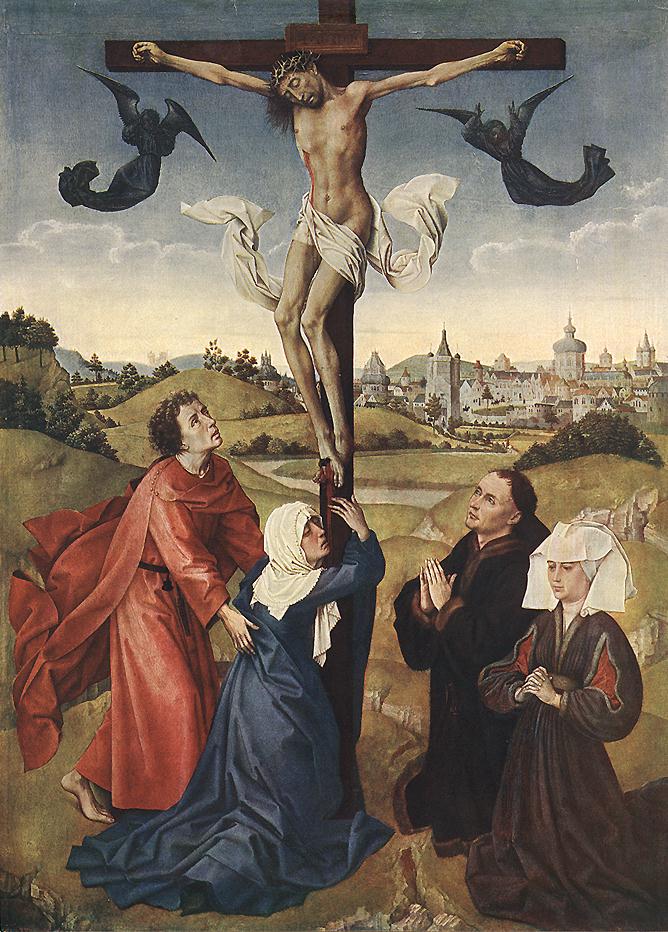
Rogier van der Weyden

Crucifixion Altarpiece, c. 1445
by Rogier van der WEYDEN
From Web Gallery of Art:
The Crucifixion Triptych, like the Seven Sacraments Altarpiece, is impressive in its composition. The two are linked not only by the use of a painted golden frame structure in the picture (not found, or not yet found, in any other surviving works by Rogier), but also in the style of the underdrawing. Both works may have been created at roughly the same time, and the dating of the triptych to around 1445, on dendrochronological evidence, would support that theory. Certainly the designs of both pictures derive from Rogier himself, but his assistants seem to have been involved in the execution, and perhaps did some of the preparatory underdrawing as well. The figures of the triptych are executed to a very high standard.
Crucifixion Triptych (central panel)


Crucifixion Triptych
(left wing)

Crucifixion Triptych (right wing)

Wednesday, March 25, 2009

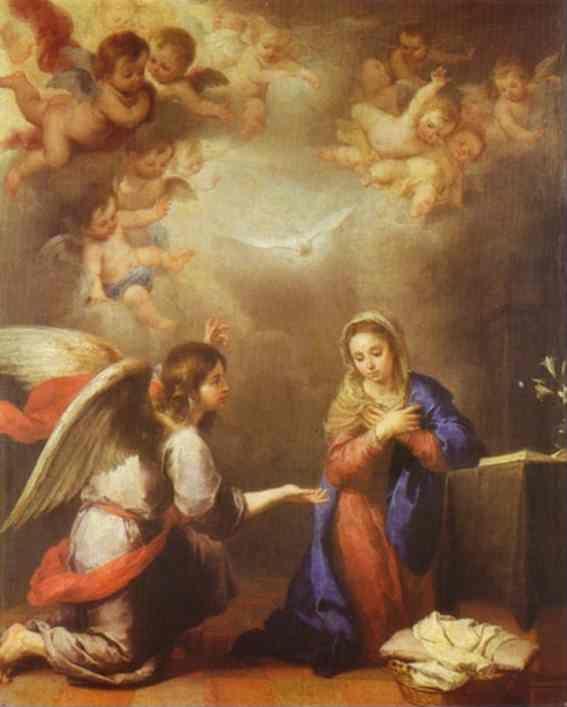
Meditation on the Annunciation


Bartolomo Esteban Murillo. Annunciation.
c.1660-65. Oil on canvas. Museo del Prado, Madrid, Spain. (Source)

A nice meditation on today's feast over at America Needs Fatima blog . . .
and also at Happy Catholic.

Luke 1: 26-35

26 And in the sixth month, the angel Gabriel was sent from God into a city of Galilee, called Nazareth, 27 To a virgin espoused to a man whose name was Joseph, of the house of David; and the virgin's name was Mary. 28 And the angel being come in, said unto her: Hail, full of grace, the Lord is with thee: blessed art thou among women. 29 Who having heard, was troubled at his saying, and thought with herself what manner of salutation this should be. 30 And the angel said to her: Fear not, Mary, for thou hast found grace with God.

31 Behold thou shalt conceive in thy womb, and shalt bring forth a son; and thou shalt call his name Jesus. 32 He shall be great, and shall be called the Son of the most High; and the Lord God shall give unto him the throne of David his father; and he shall reign in the house of Jacob for ever. 33 And of his kingdom there shall be no end. 34 And Mary said to the angel: How shall this be done, because I know not man? 35 And the angel answering, said to her: The Holy Ghost shall come upon thee, and the power of the most High shall overshadow thee. And therefore also the Holy which shall be born of thee shall be called the Son of God.


Abortion Chain Owner's Family Dies in MT Plane Crash

Abortion chain owner's family died in MT cemetery plane crash - near Tomb of the Unborn
Read more here.

As I live, says the Lord, I swear I take no pleasure in the death of the sinner, but rather in the sinner’s conversion, that he may live.

Ezek. 33:11

Monday, March 23, 2009

Ecce Homo

Antonio Ciseri (1821-91)

"Behold the man,"
The Governor, Pontius Pilate. (John 19.5)

The scene - The Praetorium, Jerusalem, 30CE

John 19
1 Then therefore, Pilate took Jesus, and scourged him. 2 And the soldiers platting a crown of thorns, put it upon his head; and they put on him a purple garment. 3 And they came to him, and said: Hail, king of the Jews; and they gave him blows. 4 Pilate therefore went forth again, and saith to them: Behold, I bring him forth unto you, that you may know that I find no cause in him. 5 (Jesus therefore came forth, bearing the crown of thorns and the purple garment.) And he saith to them: Behold the Man.

Friday, March 13, 2009

The Scourging

"Christ after the Flagellation," by Diego Velazquez
Velazquez's Jesus is scourged, yet serene: The Spanish artist depicts the soul contemplating Christ -
Sr. Wendy Beckett's interpretation.

Tuesday, March 10, 2009

Novena to St. Joseph

March is the month traditionally dedicated to St. Joseph. One of his feast days is on March 19. To honor St. Joseph, I will be join Totus Tuus in beginnning today a novena to this great saint who exemplifies so many of the qualities I lack . . . Please join us, too!
Glorious St. Joseph, model of all who are devoted to labor, obtain for me the grace to work in the spirit of penance in expiation of my many sins; to work conscientiously by placing love of duty above my inclinations; to gratefully and joyously deem it an honor to employ and to develop by labor the gifts I have received from God, to work methodically, peacefully, and in moderation and patience, without ever shrinking from it through weariness or difficulty to work; above all, with purity of intention and unselfishness, having unceasingly before my eyes death and the account I have to render of time lost, talents unused, good not done, and vain complacency in success, so baneful to the work of God. All for Jesus, all for Mary, all to imitate thee, O patriarch St. Joseph! This shall be my motto for life and eternity.

Wednesday, March 4, 2009


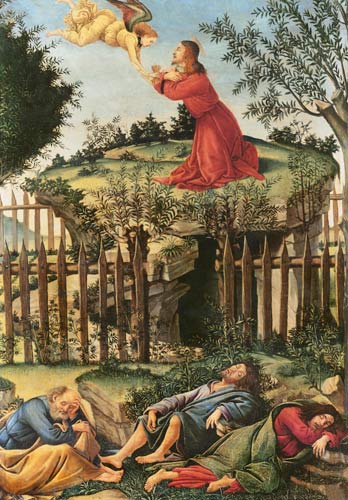
Luke 22:39-51
39 And going out, he went, according to his custom, to the mount of Olives. And his disciples also followed him. 40 And when he was come to the place, he said to them: Pray, lest ye enter into temptation.

41 And he was withdrawn away from them a stone's cast; and kneeling down, he prayed, 42 Saying: Father, if thou wilt, remove this chalice from me: but yet not my will, but thine be done. 43 And there appeared to him an angel from heaven, strengthening him. And being in an agony, he prayed the longer. 44 And his sweat became as drops of blood, trickling down upon the ground. 45 And when he rose up from prayer, and was come to his disciples, he found them sleeping for sorrow.

46 And he said to them: Why sleep you? arise, pray, lest you enter into temptation. 47 As he was yet speaking, behold a multitude; and he that was called Judas, one of the twelve, went before them, and drew near to Jesus, for to kiss him. 48 And Jesus said to him: Judas, dost thou betray the Son of man with a kiss? 49 And they that were about him, seeing what would follow, said to him: Lord, shall we strike with the sword? 50 And one of them struck the servant of the high priest, and cut off his right ear.

51 But Jesus answering, said: Suffer ye thus far. And when he had touched his ear, he healed him.

Friday, November 14, 2008

Communion of Saints

An acquaintance forwarded me an article today. It really made me think about the Communion of Saints. Many Catholics I know do not even know what this is more less practice it! An excellent and must read from the archives of the now non-existent Seattle Catholic can be found here.

Here an excerpt from the article about the protest at the annual meeting of the US Bishops:
Bishop Sheen once said, “We priests usually don’t lose our souls because we do evil. Rather, we lose our souls because we fail to do good.” This “failure to do good” was reflected in the latest Election. One of the greatest tragedies of the 2008 presidential race is that most bishops, with some exceptions, simply made a weak pro-life statement, or signed a joint pro-life document, or printed a pro-life article in their diocesan newspapers. They never mobilized the faithful to effectively fight for the unborn.
And then a reminder of some valuable Church teaching from Wikipedia:

CHURCH MILITANT AND CHURCH TRIUMPHANT
The Church Militant and the Church Triumphant
by Andrea da Firenze

The Catholic Church, or Church Universal, is traditionally divided into:

  • the Church Militant (Ecclesia Militans), comprising Roman Catholics who are living,
  • the Church Triumphant (Ecclesia Triumphans), comprising those who are in Heaven, and
  • the Church Suffering (Ecclesia Penitens) or Church Expectant (Ecclesia Expectans), comprising those Christians presently in Purgatory. This last term is used mainly in Roman Catholicism.

These terms are often used in the context of the doctrine of the Communion of Saints; although Christians may be physically separated from each other by the barrier of death, they nonetheless remain united to each other in one Church, and support each other in prayer.

The Latin word militans has a primary meaning of "serving as a soldier, military", but it acquired a secondary meaning of "to struggle, to make an effort", which is the intended sense here. Christians on earth (the Church Militant) are still struggling against sin in order that, when they die, they might go to heaven and be members of the Church Triumphant, those who have triumphed over sin. However, if this struggle is successful, but not completely so, then after death they temporarily become members of the Church Suffering before ultimately joining the Church Triumphant.

The Catholic Church commemorates the Church Triumphant and the Church Suffering on two consecutive days: All Saints Day on November 1 (the Church Triumphant), and All Souls Day on November 2 (the Church Suffering).

Friday, November 7, 2008

Words to Ponder

Some words from Fr. Corapi concerning America's "choice" (kind of ironic, isn't it?):

"The American people have now made it abundantly clear who they want to lead them, and the policies and practices that this president-elect has represented for some time, they can now claim as their own.
Actions have consequences, and I am sure God has duly noted what our priorities are in the US of A. Economic matters would seem to take precedence over moral matters; money more important than life itself to most people (I guess they don't consider almost 50,000,000 innocent
children murdered by abortion part of life).
Now we shall see what the fruit of such a tree will be. I predict that we won't have to wait long. In recent months we have seen "corrections" in the stock market, housing market, and banking
industries. Now we'll see if God orchestrates a "correction" in a country and a world that has demonstrated quite clearly that it prefers convenience and wealth to life itself.
Regardless of whatever happens next, remember there is still a God in Heaven and He loves you. He is infinitely merciful—and He is infinitely just as well."

God Bless You

Fr. John Corapi

Friday, July 18, 2008

Simple Explanation of the World's View and a Catholic View

Fr. Demets has a post with excerpts from the Pope's address to a group of disadvantaged youth :

Friday, July 18, 2008

This is Catholicism


In a few words, a Catholic view of the world.

False “gods”, whatever name, shape or form we give them, are nearly always associated with the worship of three things: material possessions, possessive love, or power. Let me explain what I mean.

Material possessions, in themselves, are good. We would not survive for long without money, clothing and shelter. We must eat in order to stay alive. Yet if we are greedy, if we refuse to share what we have with the hungry and the poor, then we make our possessions into a false god. How many voices in our materialist society tell us that happiness is to be found by acquiring as many possessions and luxuries as we can! But this is to make possessions into a false god. Instead of bringing life, they bring death.

Authentic love is obviously something good. Without it, life would hardly be worth living. It fulfills our deepest need, and when we love, we become most fully ourselves, most fully human. But how easily it can be made into a false god! People often think they are being loving when actually they are being possessive or manipulative. People sometimes treat others as objects to satisfy their own needs rather than as persons to be loved and cherished. How easy it is to be deceived by the many voices in our society that advocate a permissive approach to sexuality, without regard for modesty, self-respect or the moral values that bring quality to human relationships! This is worship of a false god. Instead of bringing life, it brings death.

The power God has given us to shape the world around us is obviously something good. Used properly and responsibly, it enables us to transform people’s lives. Every community needs good leaders. Yet how tempting it can be to grasp at power for its own sake, to seek to dominate others or to exploit the natural environment for selfish purposes! This is to make power into a false god. Instead of bringing life, it brings death.

The cult of material possessions, the cult of possessive love and the cult of power often lead people to attempt to “play God”: to try to seize total control, with no regard for the wisdom or the commandments that God has made known to us. This is the path that leads towards death. By contrast, worship of the one true God means recognizing in him the source of all goodness, entrusting ourselves to him, opening ourselves to the healing power of his grace and obeying his commandments: that is the way to choose life.

Labels:

posted by New Catholic

Monday, June 9, 2008

"She had one desire only: to love God and to serve Him in everything"

The Saint for mothers - Blessed Anna Maria Taigi. From Colleen's blog:
Blessed Anna Maria transformed her home into a real sanctuary in which God had the first place. Docile to her husband in every way, she avoided anything which might irritate him and thus disturb the family peace. Serious and hardworking, she saw to it that nothing was lacking to her family and, in so far as one in her impoverished circumstances could, she was generous to the poor.
I pray that we may find inspiration in the life of this holy wife and mother.

Wednesday, May 28, 2008

A Prayer for Daily Neglects

During a conversation with a friend, she mentioned the following prayer. I have seen it, but not paid much attention to it. But over the last couple of days, I have been working on my Rule of Life and found one of those great forms at Donna Young's on organizing household duties. I "see" how much time I do not make good use of. Lights go off as I recall excerpts from many of my spiritual readings about "wasted time". As of this past Sunday I renew my focus on fulfilling my duty stated in my blog description, but I also know my weaknesses and "idleness" will undoubtedly find a way to creep in. So I accept my weakness and trust that by leaning more on God than myself, I can overcome it. I will begin to offer this prayer daily and strive to His perfection.

Prayer for Daily Neglects

Eternal Father,
I offer Thee the Sacred Heart of Jesus,
with all its love,
all its sufferings and all its merits.

First ---

To expiate all the sins
I have committed this day and during all my life.

Gloria Patri.

Second ---

To purify the good I have done poorly this day
and during all my life.

Gloria Patri.

Third ---

To supply for the good I ought to have done,
and that I have neglected this day and all my life.

Gloria Patri.

A Poor Clare sister who had just died, appeared to her Abbess who was praying for her, and said to her: "I went straight to heaven, for, by means of this prayer, recited every evening, I paid all my debts."

Wednesday, May 14, 2008

At the Wellsprings of Traditional Life: Something I have been thinking on.....

From At the Wellsprings of Traditional Life: Something I have been thinking on.....

"Christ: My child if you desire true happiness, then I must be your ultimate goal of all your works. Too often your affections are inclined toward yourself and other creatures; direct them toward Me, and they will be purified."
This is a great quote from an even greater book! The Imitation of Christ is a spiritual classic. If you do not own a copy, run to your nearest Catholic bookstore and pick one up! A full view is available from Google Books here. The blog is worth time exploring the archives, also. Mrs. L has a wonderful Catholic blog.

Thursday, May 8, 2008

What I Am Reading . . .

I have several books going all the time. Last night I started on one a friend lent to me that I had wanted to read for quite some time. The Art of Catholic Mothering ( or from Amazon ) is by a homeschooling, Catholic mother of 5 who was so overwhelmed by motherhood that she retreated, literally an Ignatius 5-day retreat, while pregnant with her 2nd child. There she was inspired to write, or rather gather the stories, for this book. She gathered the stories of twelve Catholic mothers. From her introduction:
. . . . It was this thing called SELF SACRIFICE. No one had ever told me that motherhood and dying to self were synonymous! . . .
. . . But it wasn't all wrong; motherhood was exactly the tool that God had chosen to shape my soul and this may not be news to you, but "being shaped" rarely feels pleasant. And even in that retreat of 1997 God allowed me to see and understand that each child He would send would be yet another tool with which He would try to remove some part of SELF that wasn't Christ-like"
I am also almost finished with How Doctors Think by Jerome Groopman, M.D. I picked up my copy from my local library. This is a very informative book and I highly recommend it. I hope to give a copy to my doctor.


Tuesday, April 29, 2008

Today's Meditation

The Gospel According to Saint John 16:5-11
Haydock NT

Jesus said:

But I told you not these things from the beginning, because I was with you: And now I go to him that sent me: and none of you asketh me, Whither goest thou? But because I have spoken these things to you, sorrow hath filled your heart. But I tell you the truth: it is expedient for you that I go: for if I go not, the Paraclete will not come to you: but if I go, I will send him to you.

And when he is come, he will convince the world of sin, and of justice, and of judgment. Of sin indeed: because they have not believed in me. And of justice: because I go to the Father, and you shall see me no longer: And of the judgment: because the prince of this world is already judged.

Haydock Commentary Acts 16:22-34
Notes copied from Haydock Commentary Site

* Ver. 24. Made their feet fast in the stocks. By the Latin and Greek text, they made them fast with wood. Wi.
* Ver. 26. All the doors were opened. This made the jailer conclude the prisoners had made their escape. And he being answerable for them, and expecting to be put to death, was for stabbing himself. Wi.
* Ver. 33. Was baptized, being first told what he was to believe, and do. Wi. — Hence Catholics draw a very plausible argument for the baptism of infants, as it is very probable there were some infants in the family. See Estius in diffic.loc.

Haydock Commentary John 16:5-11

* Ver. 5. None of you asketh me, whither goest thou? S. Peter had put this question, c. xiii. 36. and Thomas, c xiv. 5. The meaning, then, of Christ’s words here, seems to be, that having told you, I am going to leave you, and also going to him that sent me, you do not ask, says S. Cyril, to be fully and thoroughly informed about it. Wi. — You suffer yourselves to be entirely overcome with grief; and none of you inquire of me, whither I am going. You look on my departure as an eternal separation between us, and take leave of me, as if we were never to meet again. But be persuaded; my absence will only be for a short continuance; and this absence will be honourable and glorious for me, and extremely advantageous for you. If you were fully persuaded of this, you would inquire how long I should be absent, and whither I was going; as one friend in the act of parting, is always accustomed to ask another. But you only torture your minds with the pain and grief you will have to suffer at my loss. Menoc. Tirin. &c.
* Ver. 6. Sorrow hath filled your heart: and this sorrow hindereth you from asking, what you should earnestly desire to know. Wi. — Peter had put the question above, c. xiii. 36. and Thomas, c. xiv. 5. But Jesus Christ means, that they did not persevere in their questions, so as to obtain satisfactory information, where, when, and for what end he was going, and how soon he was to return to them, or if to return at all. For it is customary with friends, to put the most minute questions on all these heads to friends, when they are about to be separated from each other. Menochius.
* Ver. 7. I tell you . . . it is expedient for you that I go: that I leave you, as to my corporal presence: that I suffer death, for the redemption of all men. And if I go not, the Paraclete will not come, according to the order of the divine decrees: his coming to sanctify you with his gifts, and to teach you all things, is not to be till after my ascension. When I am gone, I will send him to you. The Father and I will send him, for he proceedeth from both. Wi.
* Ver. 8. He will convince[2], or convict the world. Others translate, he will reprove the world of sin, &c. These words have occasioned a great many expositions. I here follow S. Cyril, that the Holy Ghost will condemn the Jews, and all obstinate unbelievers, of their sin, in not believing, after so many miracles, and so many pregnant motives, that ought to induce them to submit to the Christian faith. 2dly, Of justice, by shewing the justice and innocence of Christ, and also, that true justice and sanctification cannot be obtained, but by his grace. 3dly, Of judgment, by shewing that the world, and the prince of this wicked world, the devil, is justly condemned, his empire in a great measure destroyed, and that all the wicked will be justly condemned, and punished with him. Wi. — The Holy Ghost, by his coming, brought over many thousands, 1st, To a sense of their sin, in not believing in Christ. 2dly, To a conviction of the justice of Christ, now sitting at the right hand of his Father. And 3dly, To a right apprehension of the judgment prepared for them that choose to follow Satan, who is already judged and condemned. Ch. — The Greek text, in addition, has Oti ou pisteuousin eiV eme. Because they have not believed in me. This accusation and conviction of sin, cannot naturally fall on any, but the incredulous Jews. S. Aug. V. Bede, S. Chrys. Theophyl. and many others, are of opinion, that this sin was their unbelief in Jesus, after all the miracles he had done in their presence, after so many prophecies so clearly accomplished in his person, after so many prodigies and wonders, which happened at his death, at his resurrection, and after his resurrection. They are accused, and convinced of sin, particularly by sensible effects of the Holy Spirit, in the apostles, by the gift of miracles and tongues, and that supernatural knowledge, which was communicated, not only to the apostles, but also to all the first Christians. These are the means, which the Paraclete, the consoling and assisting Spirit, makes us of, to condemn, and convince the world of sin; that is, of incredulity, which is the source and foundation of all other sins. The world had calumniated and despised its Saviour. It had condemned him, as a liar, as a seducer, magician, a man possessed by the devil, a destroyer of the law of God. To which the Son of God made no resistance; he only replied, that he did not wish to take the execution of justice upon himself, and that he was not come into the world to judge the world. Therefore, he committed all to the Holy Spirit, who, in the persons of the apostles, did justice to the Son, by shewing to the whole world, his doctrines, his life, his miracles, and the accomplishment of all the ancient prophecies in his person. All that the apostles preached, they confirmed by most stupendous miracles, gained the hearts of pagans to believe Jesus as their Redeemer, and called down imprecations upon the heads of the incredulous Jews, who had rejected a prophet, visibly sent by God, a Saviour and Redeemer of his people, who, in his person, bore all the characters of the divinity. Calmet.